Yogendra Ras – Ingredients, Benefits, Uses, Dosage & Ayurvedic Properties
Description
Yogendra Ras is a classical Swarna Kalpana (gold-based Ayurvedic formulation) containing Swarna Bhasma, Ras Sindoor, and other mineral ingredients. It is regarded as a Yogavahi formulation in Ayurveda, meaning it is believed to enhance the action of other medicines when administered along with them. Ras Sindoor, one of its important ingredients, contributes to the therapeutic significance of the formulation. Traditionally, Yogendra Ras has been used in Ayurvedic practice to support neurological health, vitality, stamina, and overall well-being. It is a classical herbo-mineral preparation that is commonly administered along with other medicines to enhance their therapeutic action. In Ayurveda, it has been described for use in conditions associated with nerve weakness, paralysis, metabolic disorders, general debility, and various conditions affecting physical and mental health. Owing to its Yogavahi (catalytic) properties, this formulation is known as Yogendra Ras.

Ingredients Used in Yogendra Ras
- Ras Sindoor (Processed Mercury-Sulphur Preparation)
- Loha Bhasma (Processed Iron Ash)
- Swarna Bhasma (Processed Gold Ash)
- Abhraka Bhasma (Processed Mica Ash)
- Shuddha Mukta (Processed Pearl Ash)
- Vanga Bhasma (Processed Tin Ash)
- Kumari Saar (Aloe Vera (Aloe barbadensis) Juice)
Description of Ingredients Used in Yogendra Ras
- Ras Sindoor: Ras Sindoor is a classical Ayurvedic preparation made from purified mercury and sulphur. It is traditionally used in Ayurvedic formulations to support vitality and overall health and is considered an important component of Yogendra Ras.
- Loha Bhasma: Processed iron ash is traditionally used in Ayurveda for supporting healthy blood formation and general strength. It is also described in classical texts for use in conditions associated with weakness and debility.
- Swarna Bhasma: Processed gold ash is widely used in Ayurvedic formulations and is considered a Yogavahi ingredient that may enhance the action of other components. Traditionally, it is valued for supporting mental wellness, memory, vitality, and overall health.
- Abhraka Bhasma: Abhraka Bhasma is considered a Rasayana (rejuvenative) preparation in Ayurveda. It is traditionally used to support neurological, respiratory, and general health and is valued for its rejuvenating properties.
- Shuddha Mukta: Purified pearl ash is traditionally used to support mental calmness and balance. It is considered Pitta-pacifying and is used in Ayurvedic practice for conditions associated with excess heat, irritability, and restlessness.
- Vanga Bhasma: Processed tin ash is traditionally used in Ayurveda to support the genitourinary and digestive systems. It is also described in classical texts for promoting strength and vitality.
- Bhavana Dravya (Aloe Vera Juice): Aloe vera (Aloe barbadensis) is traditionally used in Ayurveda for supporting digestive health and maintaining the balance of the three doshas. It is also valued for its rejuvenating and cleansing properties.
Method Of Preparation of Yogendra Ras
Bhaishajya Ratnavali Vatavyadhivikara Verse No. 156-157
- Take 2 parts of purified Rasa Sindoor (a traditional Ayurvedic compound made of purified mercury and sulphur).
- Take 1 part each of Swarna Bhasma (Gold), Lauha Bhasma (Iron), Abhrak Bhasma (Mica), Vanga Bhasma (Tin), and purified Mukta Bhasma (Pearl).
- Place all of these fine mineral-metallic powders into a Khalva Yantra (stone mortar and pestle).
- Pour in fresh Aloe vera juice (Kumari) and perform Mardan (thorough grinding/trituration) until the mixture blends perfectly.
- Shape the smoothly ground mixture into a large pellet or ball.
- Wrap this pellet securely in fresh Eranda (Ricinus communis / Castor) leaves.
- Bury the wrapped pellet deep inside a heap of dry paddy grains (Dhanya / Oryza sativa) and leave it undisturbed for 3 days.
- On the fourth day, take the pellet out of the grain heap, add a touch of fresh Aloe vera juice, and grind it one final time until smooth.
- Roll the final paste into uniform medicinal tablets, making sure each tablet weighs exactly 2 Ratti (approximately 250 mg).
Indications Of Yogendra Ras
- Nerve weakness
- Epilepsy
- Diabetes
- Paralysis, hemiplegia, and facial palsy
- Diabetic neuropathy
- Hepatomegaly and splenomegaly
- Left ventricular hypertrophy
- Conditions associated with abdominal discomfort and gastritis
- General weakness affecting nerves and muscles
Dosage and Adjuvants Of Yogendra Ras
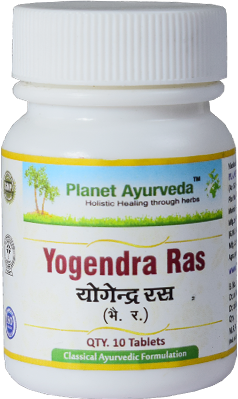

According to Bhaishajya Ratnavali, Yogendra Ras may be administered in a dose of 125 mg twice daily, before or after meals, with Vanshlochana Churna, Mishri, and Triphala Kwatha for 4–6 weeks, or as directed by an Ayurvedic physician.
Anupana (Adjuvants) According to Condition
- For Pitta disorders such as burning sensation, palpitations, and insomnia: administered with Triphala and Mishri.
- For hysteria: administer with Jatamansi (Nardostachys jatamansi) Kwatha and Mishri.
- In cardiac disorders: administer with Arjuna (Terminalia arjuna) bark decoction.
- For improving strength and vitality: administer with milk, condensed milk, or milk fat (ghee).
- In Vata disorders such as facial palsy, torticollis, nerve weakness, and paralysis: administered with Rason Ghrita and Mishri or Eranda (Ricinus communis) root juice.
- Traditionally, individuals with a lean body constitution may take this medicine with milk at bedtime, under medical supervision.
- If taken along with allopathic medicines, it is generally advisable to maintain a gap of at least 30 minutes between the two, unless otherwise directed by a healthcare professional.
CONCLUSION
Yogendra Ras is a classical Ayurvedic herbo-mineral formulation renowned for its Yogavahi (catalytic) property, which is believed to enhance the therapeutic action of other medicines when administered together. Prepared with valuable ingredients such as Swarna Bhasma, Ras Sindoor, Loha Bhasma, Abhraka Bhasma, Mukta Bhasma, and Vanga Bhasma, it holds an important place in traditional Ayurvedic practice. It is traditionally used to support neurological health, vitality, strength, and overall well-being. Ayurvedic texts describe its use in conditions such as nerve weakness, paralysis, facial palsy, epilepsy, diabetic neuropathy, and general debility. Due to its rejuvenating and strengthening properties, it is also valued for promoting physical and mental wellness. As Yogendra Ras contains mineral and metallic preparations, it should always be taken under the supervision of a qualified Ayurvedic physician. When used appropriately, it remains a significant formulation in the Ayurvedic management of various chronic and debilitating conditions.