All about MRI – Importance, What does it diagnose? When is it recommended and for which Body Part
In the journey of human health, the shift from mere symptomatic observation to deep, non-invasive visualization of internal organs marks one of the most profound advancements in medical science. From stethoscopes to sophisticated imaging, modern diagnostics has bridged the once-insurmountable gap between visible symptoms and hidden pathology. With precision as its compass, medical imaging now empowers physicians to witness disease in its infancy—far before it manifests overtly. Among these tools, Magnetic Resonance Imaging (MRI) emerges as a marvel of innovation, harnessing magnetic fields and radio waves to render intricate, three-dimensional views of the human body. Unlike other scans, MRI avoids ionizing radiation, making it a safer option in many contexts. Whether decoding mysteries of the brain, joints, or spinal cord, MRI has revolutionized our approach to diagnosis. It stands not just as a machine, but as a milestone in mankind’s pursuit to understand the unseen. In this article, we shall know more about MRI !!
Introduction
Magnetic Resonance Imaging (MRI) stands at the forefront of modern diagnostic medicine, providing unparalleled views of the human body’s soft tissues. Since its clinical emergence in the early 1980s, MRI has evolved into a vital tool for detecting cancers, neurological disorders, musculoskeletal conditions, and cardiovascular abnormalities. Unlike X-rays or CT scans, MRI avoids ionizing radiation and leverages magnetic fields and radio waves for imaging, making it especially suitable for repeated or detailed examinations. Advanced sequences and high-field systems now enable scanning from brain to joints, heart, and even fetal structures—blurring the line between diagnosis and molecular insight. In an era where precision matters, MRI offers clarity, safety, and diagnostic power. Furthermore, integrative healthcare approaches increasingly align MRI’s anatomical precision with time-honored Ayurvedic wisdom to support holistic patient care.
What is MRI?
MRI (Magnetic Resonance Imaging) is a non-invasive imaging technique that uses strong magnetic fields and radiofrequency waves to produce high-resolution images of internal structures, particularly soft tissues, organs, and the nervous system. Unlike CT, which depends on X-rays, MRI generates contrast by aligning hydrogen protons in the body and detecting their signals once excited by radio pulses. This lack of ionizing radiation makes MRI a preferred choice for neurological, musculoskeletal, and abdominal imaging where detailed soft-tissue visualization is crucial. Its evolution introduced variants such as functional MRI (fMRI), MR angiography, and higher-field magnets (3 T and above), expanding both diagnostic scope and research capabilities.
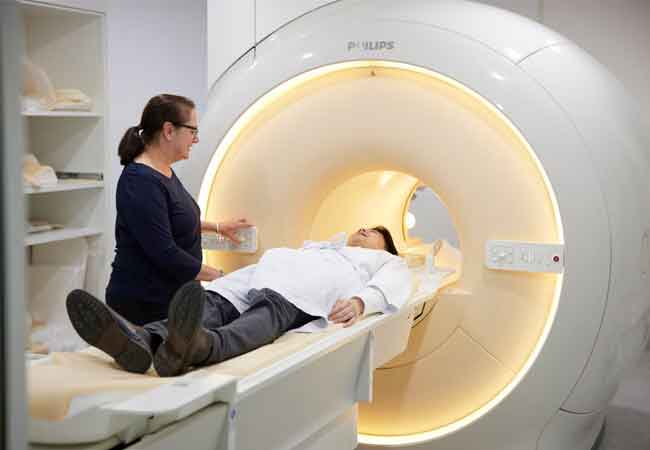
Procedure / How to Do?
- Preparation
- Patients complete safety checks (metal implants, pacemakers, etc.) due to strong magnetic fields.
- Fasting may be required for contrast-enhanced scans; medication schedules are reviewed.
- Positioning & Comfort
- The patient lies on a movable table inserted into the MRI bore. Ear protection is provided due to loud noises.
- Sedation may be offered for claustrophobic patients.
- Scan Execution
- Coils are placed near the targeted area; relaxation time varies by body part and contrast use.
- MRI typically takes 20 minutes to over an hour; contrast introduces minimal extensions.
- Post-Scan Care
- Patients remove ear protection and rest briefly before leaving.
- Hydration aids contrast elimination; patients resume activities unless sedated.
- Results
- Radiologists interpret images, delivering reports within 24–48 hours.
How MRI Works
MRI harnesses magnetic fields to align hydrogen nuclei; radiofrequencies excite these nuclei. As they relax, emitted signals are captured and reconstructed into cross-sectional images using Fourier transforms. Gradient coils provide spatial encoding in multiple planes. Variations in relaxation times (T1, T2) yield contrasts between tissues—greatly differentiating fat, fluid, and muscle. Advanced techniques extend capabilities:
- Functional MRI (fMRI) maps brain activity via blood-oxygen-level changes
- MR Angiography (MRA) visualizes blood vessels without X-ray contrast
- Diffusion/Tensor Imaging tracks nerve pathways.
High-field MRI scanners (1.5–3 T) improve resolution and scan speed, enabling sharper views of brain, spinal cord and cardiac structures.
Importance of MRI
MRI’s strengths include:
- Neurology: Visualizes tumors, multiple sclerosis, stroke, epilepsy, and more.
- Musculoskeletal: Assesses ligament tears, cartilage damage, spine issues, and joint pathology, offering multiplanar imaging.
- Cardiac: Detects myocardial scarring, evaluates congenital heart disease, valves, and vessels with exceptional detail.
- Oncology: Stages tumors, maps extent, and monitors treatment response in brain, liver, prostate, and breast cancers.
- Abdominal Imaging: Explores liver, pancreas, kidneys, and pelvic organs with high soft-tissue resolution.
- Pediatric & Prenatal Use: Safe imaging of children and fetuses without radiation concerns.
MRI plays a key role in surgical planning, minimally invasive procedures, and guiding biopsies, making it indispensable in modern diagnostics.
When It’s Done
MRI is ordered when detailed imaging is essential and radiation avoidance is preferred:
- Brain & Spinal Cord: For stroke evaluation, tumors, demyelination, or nerve compression.
- Joints & Musculoskeletal: For ligament tears, sports injuries, arthritis.
- Heart & Vessels: When CT angiography is not suitable or radiation minimization is critical.
- Abdomen & Pelvis: For masses, inflammation, structural anomalies.
- Breast Cancer: In high-risk screening or dense breast tissue situations.
- Pediatrics: For congenital issues, neurologic disorders, or serial monitoring without radiation.
MRI is also chosen when CT results are inconclusive, or repeated scans are expected.
Any Risks After MRI?
MRI is remarkably safe but includes a few considerations:
- Metal Implants: Incompatible devices (pacemakers, aneurysm clips) can pose risk and are often not permitted.
- Contrast Agents: Gadolinium contrast carries small allergy risk (~0.03–0.1%) and requires kidney function tests.
- Claustrophobia: Up to 5% may experience anxiety; open-bore scanners or sedation can help.
- Peripheral Nerve Stimulation: Rare twitching during rapid gradient switching.
- Projectile Hazard: Strict screening protocols prevent ferromagnetic objects entering the MRI suite.
- Pregnancy: Acceptable without contrast anytime; contrast MRI avoided particularly in the first trimester.
With proper safety measures, MRI remains one of the most benign imaging modalities.
Approximate Cost in India
MRI costs in India vary by body region and facility type
| Scan Type |
Price Range (₹) |
| Head/Brain | ₹3,000–7,000 |
| Spine | ₹4,000–9,000 |
| Knee | ₹3,000–6,500 |
| Abdomen/Pelvis | ₹6,000–12,000 |
| Full-body | ₹10,000–25,000 |
Contrast-enhanced scans may incur an extra ₹1,000–3,000. Prices are lower in public hospitals but can reach ₹30,000 in premium private centers.
How Ayurveda Helps
While MRI provides objective, structural insights, Ayurveda complements its findings through holistic, supportive care:
- Before Imaging: Herbal detoxification (e.g., Triphala Rasayana) and stress-reduction via daily rituals prepare patients for scan procedures.
- Post-Diagnosis Support: Breathing exercises, herbal formulations, and Panchakarma therapies soothe systemic inflammation and aid tissue recovery.
- Chronic Disease Management: Guided by MRI findings, Ayurveda offers personalized diet, lifestyle, and herbal plans—supporting neurological, musculoskeletal, cardiac, or abdominal regeneration.
- Integrative Practice: Public hospitals now house integrative teams—enabling MRI-informed Ayurvedic follow-up in conditions like osteoarthritis and spinal disorders.
- Patient Empowerment: Ayurveda encourages active engagement through yoga, meditation, and personalized routines—improving well-being alongside MRI-validated treatment plans.
Conclusion
MRI has emerged as an essential diagnostic instrument—effortlessly bridging structure and function without radiation. Its precision in soft tissue imaging, coupled with advanced modalities like fMRI and angiography, makes it indispensable across specialties. While its cost in India—ranging ₹3,000 to ₹25,000—makes it accessible, its safety profile and versatility elevate its clinical value. Beyond imaging, integrating Ayurvedic principles amplifies recovery and supports long-term healing. As MRI technology and traditional wellness continue to converge, medicine moves toward a future where data-driven precision and ancient wisdom work hand in hand toward comprehensive care.
FAQ Section
Q1. How long does an MRI scan take?
Typically 20–60 minutes depending on region and contrast use.
Q2. Is MRI safe during pregnancy?
Yes—MRI without contrast is safe at any trimester. Contrast use is avoided in early pregnancy.
Q3. Can people with pacemakers get MRI?
Only if they have MRI‑conditional devices. Unsafe devices are a contraindication.
Q4. Any side effects from contrast?
Rare allergic reactions (0.03–0.1%) and considerations for kidney health.
Q5. Why choose MRI over CT?
Superior soft‑tissue detail without radiation, ideal for brain, spine, joints, and repeated imaging.
Q6. Can claustrophobic patients handle MRI?
Yes—options include mild sedation, open‑bore scanners, or audio‑visual support.
Q7. Are there any long-term risks?
No ionizing radiation is used; safety is excellent when contraindications are followed.
Q8. How soon do results arrive?
Reports usually within 24–48 hours; urgent cases are expedited.
Q9. Are MRIs expensive?
They are more expensive than X-rays/CT, but offer superior detail. Costs in India range ₹3,000–25,000 depending on scan type.