Kalari Massage vs Abhyanga – India’s Most Powerful Traditional Healing Therapies
Introduction
A Continent of Touch
Long before the world discovered “wellness,” India had already mapped the human body in extraordinary detail – its energy channels, its marma points, its rivers of oil and breath. Out of this ancient knowledge, two massage traditions emerged that are, in many ways, mirror opposites: one born in the heat of a martial arts arena, the other in the quiet of an Ayurvedic healing center. Both use oil. Both honour the body as sacred. And yet, the moment a practitioner’s hands touch your skin, you know immediately which world you have entered.
This is the story of Kalaripayattu massage known as Kalari massage or Chavitti Uzhichil – and Abhyanga, the jewel of Ayurvedic bodywork. Understanding what makes each unique is to understand something profound about how India has always thought about the body: not just as flesh, but as philosophy.
Part One: Kalari Massage – The Warrior’s Alchemy
Origins in the Arena
- To understand Kalari massage, you must first understand Kalaripayattu – one of the world’s oldest surviving martial arts, born in the lush, rain-drenched state of Kerala, possibly as far back as the 3rd century BCE. The kalari is the training ground, a sunken rectangular pit of red earth where students learn to fight with swords, spears, and their own bodies. It is a place of discipline, pain, and transformation.
- In this context, massage was never a luxury. It was medicine. Warriors trained their bodies to extremes – muscles torn, joints stressed, nerves fatigued and they needed a system of recovery as sophisticated as the combat itself. Kalari masters (gurukkal) developed a precise knowledge of the body’s 107 marma points, the anatomical junctions where flesh, bone, and life energy converge. An injury to a marma point in battle could be fatal. But the same knowledge, applied through massage, could heal.
What Is Kalari Massage?
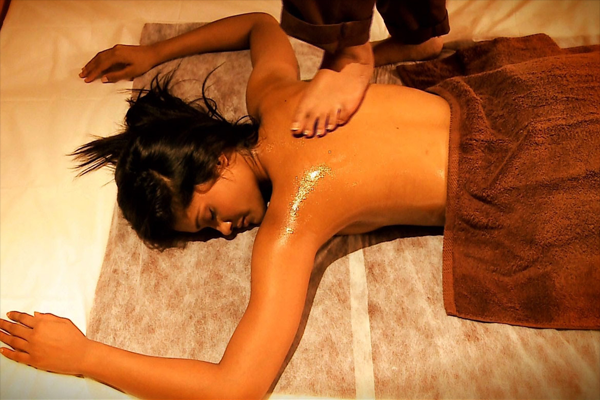
- Kalari massage is a vigorous, deeply therapeutic form of bodywork administered by a trained gurukkal or their senior student. It comes in several forms, the most dramatic of which is Chavitti Uzhichil “foot massage” in Malayalam in which the therapist uses their feet rather than their hands to apply pressure, balancing with ropes suspended from the ceiling to control force and direction.
- This is not a technique for the faint of heart. The therapist walks along the recipient’s back, legs, and arms in long, rhythmic strokes, using the sole and heel of the foot to penetrate layers of muscle that hands simply cannot reach. The pressure is immense, but under a skilled practitioner it is never brutal– it is surgical.
The Oil: Medicated, Potent, and Time-Honoured
- The oils used in Kalari massage are not the mild sesame or coconut blends of everyday Ayurveda. They are kizhi preparations and complex herbal decoctions, some recipes closely guarded family secrets passed down through generations of gurukkal lineages. Common bases include sesame oil infused with dozens of medicinal herbs: Bala (Sida cordifolia) for nerve strengthening, Ashwagandha for muscle recovery, and specific formulations for particular injuries or constitutions.
- The oil is always warmed before application and used in generous quantities. In many traditions, the body is marinated in oil, the therapist ensures it penetrates deeply into the muscle tissue before the deep pressure work begins.
The Treatment: A Map of the Body’s Rivers
- A traditional Kalari massage session begins not with small talk, but with observation. The gurukkal studies the recipient’s posture, their gait, the way they hold tension in their jaw. Then the work begins.
- Starting at the feet – always the feet, as a mark of humility and because the feet carry the weight of the whole body – the therapist works upward in long, sweeping movements that follow the direction of nadis (energy channels). The strokes are deeper and more directional than in Abhyanga: less circular, more linear, following the architecture of muscles along their length.
- When the foot massage (Chavitti Uzhichil) is employed, the recipient lies on a mat on the floor, and the practitioner begins to walk – slowly, rhythmically, breathing in sync with their movements. The sensation is extraordinary: a pressure so deep it seems to reach the bones, yet balanced by the warm oil and the therapist’s controlled weight distribution so that it never tips into pain.
- The marma points receive special attention. Each of the 107 points is stimulated with precise circular pressure – not the broad strokes used on muscle bellies, but targeted, deliberate touch that practitioners describe as “waking up” the energy at that location. Some points produce radiating warmth; others cause a mild, transient ache that fades into release.
Who Is It For?
- Traditionally, Kalari massage was reserved for martial arts practitioners. Today, it has found a wider audience – particularly among those dealing with chronic musculoskeletal issues, sports injuries, compressed or herniated discs, sciatica, and deep muscular tension that conventional massage cannot reach. It is also used as a preparation for flexibility training, as the deep muscle work dramatically increases range of motion.
- It is not recommended for anyone with acute injuries, skin conditions, fever, or those who are pregnant. The intensity of the treatment demands a body that is ready to receive it.
The Philosophy Behind the Practice
At its heart, Kalari massage carries the philosophy of Kalaripayattu itself: the body is a weapon, but it is also a temple. Every practitioner is trained to understand that their hands (or feet) are instruments of both destruction and healing – and that this duality is the same duality that exists within every human being. The massage is therefore not merely physical; it is a reminder of the body’s extraordinary capacity to endure, recover, and become stronger.
Part Two: Abhyanga – The Ayurvedic Embrace
Origins in the Science of Life
Abhyanga comes from a different world entirely. Where Kalari massage was born on the training ground, Abhyanga was born in the vaidyashala – the Ayurvedic physician’s clinic – codified in ancient texts like the Charaka Samhita and Ashtanga Hridayam, composed over two thousand years ago.
The word Abhyanga comes from Sanskrit: abhi (towards, into) and anga (limb, body). It is literally the act of anointing the body – moving oil into the tissues
In classical Ayurveda, Abhyanga is not a weekly indulgence; it is a daily practice (dinacharya) recommended for almost every person as a foundation of preventive health. Abhyanga is the one that eliminates aging, fatigue, and Vata disorders.
The Ayurvedic Lens: Doshas and the Body’s Constitution
- To understand Abhyanga fully, you need Ayurveda’s most fundamental concept: the three doshas – Vata (air and space), Pitta (fire and water), and Kapha (earth and water). Every individual is born with a unique combination of these forces, and health is maintained when they are in balance. Illness arises when they are not.
- Abhyanga is among the most powerful tools Ayurveda offers for balancing the doshas, particularly Vata – the dosha of movement, dryness, anxiety, and irregularity. Vata, when aggravated, manifests as dry skin, cracking joints, restlessness, insomnia, and a scattered mind. Oil, warmth, and rhythmic touch are its antidote.
The choice of oil in Abhyanga is therefore personalised to the recipient’s constitution (prakriti) and current imbalance (vikriti):
- Vata types receive warm sesame oil, heavy and grounding
- Pitta types receive cooling coconut or sunflower oil
- Kapha types receive lighter mustard or safflower oil, often with warming herbs.
Medicated oils (taila) infused with specific Ayurvedic herbs address particular conditions
The Treatment: A Symphony of Strokes
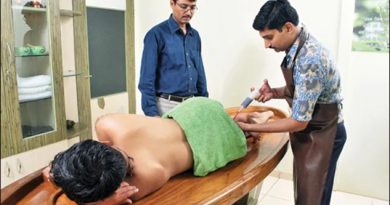
- An Abhyanga session begins with the practitioner warming the oil – never cold oil on the body, Ayurveda insists, as cold contracts and defeats the purpose. The recipient lies on a wooden treatment table (droni), often carved from a single piece of neem or teak, which is itself considered therapeutic.
- The massage follows a precise sequence. It typically begins at the head – shiro abhyanga (head massage) – with oil worked slowly into the scalp at specific points corresponding to the brain and nervous system. Then the face, the neck, the shoulders.
- The strokes of Abhyanga are its most distinctive feature. They are long and flowing – following the direction of hair growth and the flow of lymph – but they are not the deep, penetrating strokes of Kalari massage. They are rhythmic, loving, almost hypnotic. A trained Abhyanga practitioner speaks of entering a meditative state during the treatment, their hands moving like breath – automatic, continuous, present.
- Long strokes (effleurage) are used on the limbs, always directed toward the heart to support venous and lymphatic return. Circular strokes are used at the joints- ankles, knees, hips, shoulders, elbows, wrists- acknowledging that joints are places of particular vulnerability to Vata aggravation.
- The abdomen receives special attention: clockwise circular strokes following the path of the large intestine, gentle pressure on the navel (the body’s energetic centre in Ayurveda), and soft kneading of the digestive organs. This is profoundly different from Kalari massage, where the abdomen is rarely a focus.
- The session ends at the feet- pada abhyanga – where the sole of each foot is worked with the thumb in small, firm circles at points corresponding (in Ayurvedic foot reflexology) to every organ in the body.
The Experience – Dissolution
- If Kalari massage is an awakening- a deep, sometimes challenging encounter with the body’s strength and vulnerability- Abhyanga is a dissolution. Recipients frequently describe the experience as a return to something primordial: the warmth of the oil, the unbroken rhythm of the strokes, the softening of every boundary between tension and release.
- It is not uncommon to drift into a state that is neither quite waking nor quite sleeping- what Ayurveda calls yoga nidra – during a skilled Abhyanga treatment. The nervous system, flooded with the warmth and rhythm of the massage, begins to let go of its chronic holding patterns. The oils, absorbed through the skin, begin their slow work on deeper tissues.
After Abhyanga: The Steam
Classical Abhyanga is traditionally followed by swedana – steam therapy. The body, saturated with oil, is placed in a steam cabinet or tent, allowing the heat to drive the oil deeper into the tissues. This combination- oil and steam- is considered by Ayurveda to be among the most powerful detoxifying and nourishing treatments available.
Who Is It For?
Abhyanga is for almost everyone, which is precisely why classical Ayurveda recommends it as a daily self-practice. It is particularly beneficial for those experiencing anxiety, insomnia, dry skin, stiff joints, fatigue, and the general depletion that comes from a busy, modern life. It supports immunity, improves circulation, nourishes the nervous system, and according to Ayurvedic tradition – adds years to one’s life.
Contraindications are relatively few: avoid during fever, acute illness, menstruation (for full-body treatment), and during the first trimester of pregnancy.
Part Three: The Great Comparison – How They Differ
Now that we have walked through each tradition in its own terms, let us place them side by side.
1. Intention and Philosophy
- Kalari massage is fundamentally restorative and strengthening. It asks: What in this body needs to be unlocked, rebuilt, and made ready for challenge? It comes from a tradition that sees the body as an instrument of power.
- Abhyanga is fundamentally nourishing and harmonising. It asks: What in this body needs to be soothed, balanced, and brought back to its natural state? It comes from a tradition that sees the body as the dwelling of the self.
2. Pressure and Technique
- This is the most immediately felt difference. Kalari massage applies deep, penetrating pressure- sometimes using the therapist’s full body weight via the feet- targeting muscle bellies, tendons, and marma points with precision. It can be intense, even momentarily uncomfortable, though always purposeful.
- Abhyanga applies moderate, rhythmic pressure – primarily through the hands – using strokes that are enveloping and continuous rather than probing. It is rarely uncomfortable; it is designed to soothe rather than penetrate.
3. The Role of Oil
- Both traditions revere oil as medicine, but they use it differently. In Kalari massage, oil is a medium and a medicine- necessary for the deep work to proceed without injury, and chosen for its therapeutic properties for specific conditions. It is applied before and during treatment.
- In Abhyanga, oil is the primary therapeutic agent itself. The massage technique exists, in a sense, to deliver the oil deep into the tissues. The strokes are as much about ensuring absorption as about mechanical tissue work.
4. Scope of Treatment
- Kalari massage focuses intensely on musculoskeletal and nervous system health- muscles, tendons, joints, the channels of the nervous system as understood through marma theory. It is specific and targeted.
- Abhyanga treats the whole person through the whole body – musculoskeletal, nervous, digestive, endocrine, and emotional systems are all addressed through the Ayurvedic understanding of how oil and touch affect the doshas. It is holistic and constitutional.
5. Speed and Rhythm
- Kalari massage has a variable rhythm – slow and deliberate on key marma points, sweeping and firm along muscle bellies, occasionally pausing to apply sustained pressure. There is a quality of investigation in the touch, as if the therapist is reading the body and responding.
- Abhyanga has a consistent, hypnotic rhythm – the speed rarely varies dramatically, and the continuity of touch is considered therapeutically essential. To break the rhythm is to break the spell.
6. Training and Lineage
- A Kalari massage therapist is typically a Kalaripayattu practitioner first – they have undergone years of martial training and understand the body from the inside out. Their knowledge of marma points is not academic; it is embodied.
- An Abhyanga practitioner is trained in Ayurvedic medicine – they understand the body through the lens of doshas, tissues (dhatus), and channels (srotras). Their assessment is constitutional, considering the patient’s whole health picture before touching them.
Part Four: Which Massage Is Right for You?
These two traditions are not competing- they are complementary. Different bodies, at different moments, need different things.
1. Choose Kalari massage
if you are dealing with deep chronic tension, old injuries that have never quite resolved, restricted range of motion, nerve compression, or if you are an athlete who wants to push the limits of physical performance. Come prepared for an intense, deeply transformative expe
rience that may leave you sore before it leaves you healed.
2. Choose Abhyanga
- Abhyanga if you are exhausted, anxious, depleted, struggling with sleep, or simply in need of deep nourishment. Come prepared to dissolve- to hand your nervous system over to the care of warm oil and steady, loving hands and if you are fortunate enough to be in Kerala, where both traditions are alive and practised in their authentic forms, consider experiencing both. In doing so, you will have touched two of the most sophisticated bodywork traditions in human history – one forged in the heat of combat, the other in the quiet pursuit of longevity.
Epilogue: The Intelligence of Ancient Hands
What strikes any thoughtful observer of both traditions is how much they knew- these ancient practitioners of Kerala and classical India- without MRI machines or biochemistry labs. They mapped the nervous system through marma points. They understood inflammation and recovery through the language of doshas. They knew that the feet could reach places the hands could not. They knew that rhythm could put the nervous system to sleep.
The body has not changed. Its rivers run the same. And in the hands of a true practitioner of either tradition, something extraordinary becomes possible: not just the relief of pain, but the remembrance of what the body is capable of when it is truly cared for.
Both Kalari massage and Abhyanga are best experienced with qualified, traditionally trained practitioners. If you are in India, Kerala remains the heartland of both traditions and is home to many Authentic Treatment centres and Ayurvedic hospitals where these arts are practised in their classical form.