The Self-Remodeling Skeleton – How Movement Signals Your Cells to Build Stronger Bones
Introduction
It is easy to mistake our bones for rigid, static scaffolding—inert structures that merely support our weight and protect our organs. However, this is a profound biological myth. In reality, your skeleton is a dynamic, living organ system that undergoes constant transformation. Through a lifelong process known as bone remodeling, your body continuously tears down old, fatigued bone tissue and replaces it with fresh, resilient material. This invisible cycle relies on a perfectly synchronized cellular dance: osteoclasts systematically dissolve aging bone, while osteoblasts follow closely behind to construct a new mineral matrix. Far from being permanent, your skeleton effectively replaces itself about every ten years. This perpetual renewal ensures your bones remain structurally sound, adapt to physical stress, and actively contribute to your body’s daily metabolic demands. Let’s study in detail!
The Science of Bone Remodeling
Beneath the surface, your skeleton is in a perpetual state of renewal, governed by a highly coordinated cellular trilogy: osteocytes, osteoclasts, and osteoblasts. Together, these specialized cells execute the continuous replacement of old, micro-damaged bone with a fresh, resilient matrix. The process begins with osteocytes, mature bone cells embedded deep within the mineralized tissue. Acting as mechanosensors, they detect physical stress, microfractures, or systemic hormonal signals. When structural wear is identified, osteocytes send chemical signals to recruit osteoclasts. These specialized cells act as the demolition crew, anchoring to the bone surface and secreting acid and enzymes to dissolve the mineral and protein framework. This phase, known as resorption, leaves behind a tiny cavity. Once the old bone is cleared, the construction phase begins. Signals trigger the arrival of osteoblasts, the bone-building cells. Osteoblasts line the cavity and secrete osteoid, a rich collagen matrix that fills the excavation site. Over the subsequent weeks, calcium and phosphate crystallize within this matrix, mineralizing it into hard, new bone. As the osteoblasts finish their work, some become trapped within their own architectural creation. These trapped cells mature into new osteocytes, ready to monitor the newly formed tissue. This flawless, cyclical dance ensures that your skeleton maintains structural integrity, adapts to physical demands, and optimizes systemic mineral balance throughout your life.
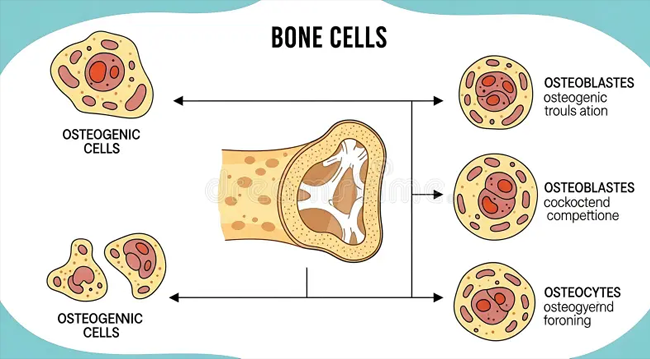
Movement: The Language Bones Understand
Bones do not just exist in a vacuum; they listen and adapt to how we move. Through mechanical loading—the physical stress placed on the skeleton during weight-bearing exercise—bones receive the critical signals they need to stay strong. When you walk, lift weights, or jump, the physical force deforms the bone matrix on a microscopic level. This subtle bending forces interstitial fluid to flow through the tiny channels surrounding osteocytes, the skeleton’s resident sensor cells. Detecting this fluid shear stress, the osteocytes translate physical mechanical energy into biochemical language. They quickly broadcast cellular signals that suppress bone-dissolving osteoclasts and stimulate bone-building osteoblasts. By converting the mechanical strain of movement into cellular action, your skeleton dynamically reinforces itself precisely where it is needed most, proving that movement is truly the vital language of bone health.
Meet the Bone’s Master Sensors: Osteocytes
Though encased in a rigid mineral matrix, osteocytes function as the central nervous system of the skeleton. These star-shaped cells form a vast, interconnected communication network via microscopic channels called canaliculi, allowing them to sense real-time pressure, gravity, and mechanical strain. When physical load deforms the bone, it forces interstitial fluid to rush through these canaliculi. Osteocytes detect this fluid shear stress through specialized surface structures, such as primary cilia and integrins. This mechanical trigger activates complex intracellular signaling pathways—most notably suppressing sclerostin, a protein that naturally halts bone growth. By silencing this inhibitor, osteocytes effectively flip a biochemical switch that unleashes the Wnt/β-catenin pathway. This cascade sends an urgent signal to recruit and activate bone-building osteoblasts, proving that osteocytes are the master conductors of skeletal adaptation.
Which Movements Build the Strongest Bones?
Bones do not respond to all movements equally. To spark the cellular signaling that drives bone density, mechanical stress must be dynamic, varied, and exceed your body’s everyday threshold. Three primary modalities deliver the precise forces required to reshape and fortify your skeleton:
- Weight-Bearing Exercises: These movements force you to work against gravity while staying on your feet. Activities like brisk walking, hiking, and climbing stairs apply continuous axial loading through your hips and spine. This consistent vertical pressure signals osteocytes to reinforce the lower skeleton, sustaining structural integrity over time.
- Resistance Training: While weight-bearing exercise relies on gravity, resistance training uses muscular force. When you lift weights, use resistance bands, or perform bodyweight movements like squats and push-ups, pulling muscles tug aggressively on their bony attachments. This localized mechanical tension stimulates bone remodeling precisely at the sites of highest muscular stress, noticeably improving localized cortical thickness.
- Impact Activities: High-velocity, explosive movements provide the most potent stimulus for rapid bone formation. Activities such as jumping, running, and tennis subject the skeleton to sudden, multi-directional ground reaction forces. These rapid spikes in mechanical load cause brief, tiny deformations in the bone matrix, causing cellular fluid to rush through osteocyte networks and triggering an immediate bone-building response.
The Threshold Rule
For an exercise to trigger bone adaptation, it must feature novelty or intensity. Repetitive, low-impact movements like swimming or cycling fail to challenge the skeleton significantly because they minimize gravitational impact and fluid shear stress.
When Bones Stop Receiving the Signal
Just as physical stress signals bones to grow stronger, the absence of mechanical force sends a clear signal to the body that dense bones are an unnecessary metabolic luxury. When a lifestyle becomes sedentary, or when physical injury forces prolonged immobilization, the cellular conversation shifts dramatically. Without the fluid shear stress that triggers osteocytes, the bone-building Wnt/β-catenin pathway falls silent, and production of the bone-growth inhibitor sclerostin surges. This biochemical shift leaves the bone-dissolving osteoclasts unchecked, leading to a steady decline in both cortical thickness and trabecular architecture. Space travel serves as the ultimate, accelerated demonstration of this phenomenon. In a microgravity environment, the normal mechanical cues of walking and standing vanish entirely. Astronauts lose up to 1% to 1.5% of their bone mineral density in the hips and lower spine for every single month spent in space. This rapid deterioration mimics a severe, highly accelerated form of osteoporosis, highlighting that skeletal integrity is entirely dependent on the continuous message of physical load.
Nutrition: The Building Materials for Remodeling
If movement is the architectural blueprint that commands bones to adapt, nutrition provides the physical raw materials required to execute the build. Without an adequate supply of key macronutrients and minerals, the bone-building osteoblasts cannot properly synthesize and mineralize the new bone matrix.
- Protein: Comprises roughly 50% of bone volume. It forms the essential collagen framework (osteoid) that gives bone its flexibility and tensile strength.
- Calcium & Phosphorus: The primary structural minerals that crystallize along the collagen matrix to form hydroxyapatite, giving bones their rigid, compressive strength.
- Vitamin D: Acts as the critical hormonal gateway, regulating intestinal absorption of calcium. Without it, the body cannot effectively utilize dietary calcium.
- Magnesium: Essential for converting Vitamin D into its active form and maintaining structural crystal quality within the bone matrix.
- Trace Minerals (Zinc, Manganese, Copper): Serve as vital cofactors for specific enzymes during collagen synthesis and cross-linking.
Why Movement and Nutrition Must Work Together
Skeletal health requires a flawless synergy between mechanical stimulus and nutritional abundance. They cannot work effectively in isolation. If you consume a flawless, nutrient-rich diet but remain sedentary, the body lacks the mechanical justification to deposit those minerals into the skeleton; the unused calcium is simply excreted or diverted elsewhere. Conversely, if you engage in heavy resistance training or high-impact exercise without adequate nutritional support, the osteoblasts are signaled to build but lack the structural bricks to do so, leaving the bone vulnerable to micro fractures and stress injuries. Optimal bone density is only achieved when mechanical loading commands the construction and optimal nutrition fuels it.
Can Bone Strength Be Improved at Any Age?
Yes. While the peak window for banking bone density closes around age 30, you can improve bone strength and structural quality at any age. In youth, training maximizes absolute mineral density. In older adulthood, target mechanical loading flips the cellular switch to slow age-related bone loss, preserve fragile trabecular architecture, and reinforce cortical thickness. Furthermore, resistance and impact training improve muscular power, balance, and joint stability. By strengthening the supportive neuromuscular framework, you significantly minimize fall risks and fracture vulnerability—proving that the skeleton remains highly responsive and adaptable throughout your entire life.
Ayurveda’s Insight!
In classical Ayurvedic literature, bone tissue is recognized as Asthi Dhatu, a vital structural layer governed by the earthly and airy elements. According to the foundational Principles of Dhatu Poshana (tissue nourishment), each bodily tissue feeds the next in a sequential cascade. Asthi Dhatu is nourished directly by Meda Dhatu (fat tissue), and its health is deeply intertwined with Vata Dosha, the principle of movement, air, and space. As the body ages, or when it is subjected to improper diet and sedentary habits, Vata naturally increases, manifesting as dryness, porosity, and fragility within the empty spaces of the skeletal matrix. Because Asthi and Vata share an inverse relationship, an excess of Vata directly depletes bone density. True skeletal strength requires a holistic strategy: nourishing the bone matrix from within, regulating metabolic fire (Dhatu Agni), and calming unstable Vata through specific, bio-available herbo-mineral synergies. To bridge the gap between classical wisdom and modern structural needs, targeted botanical formulations offer profound systemic support for remodeling, mineral absorption, and structural density.
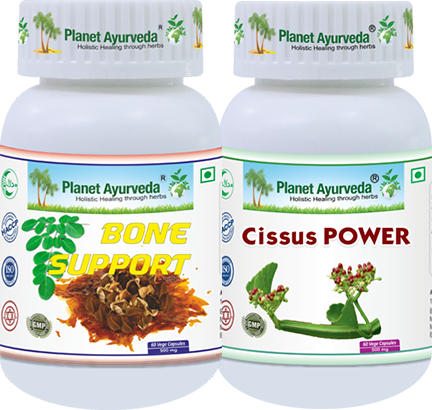

1. Bone support Capsules
Planet Ayurveda’s Bone Support capsules combine targeted botanicals with bio-available mineral preparations to deeply nourish the skeletal matrix. The synergistic formula features Hadjod (Cissus quadrangularis) and Shudh Laksha, which function as natural tissue binders that stimulate bone-building osteoblasts and accelerate collagen synthesis. To complement this cellular regeneration, Arjun and Suhanjana Beej improve localized circulation and offer anti-inflammatory support to the surrounding joints. Finally, the inclusion of Praval Pishti and Mukta Pishti provides micro-refined coral and pearl calcium. This ensures that when mechanical movement signals the skeleton to reinforce itself, the body has a highly absorbable, easily digestible supply of organic raw materials readily available.
Dosage– 1 cap twice daily with plain water after meals.
2. Cissus power capsules
Planet Ayurveda’s Cissus power capsules are prepared using Standardized extract of Centering on Hadjod (Cissus quadrangularis), traditionally celebrated as “the bone setter,” this formulation drives rapid cellular adaptation and targeted structural repair. At the cellular level, it accelerates remodeling by actively stimulating the proliferation of bone-building osteoblasts while balancing bone-dissolving osteoclast activity. Its natural phytosterols and ketosteroids providevital anabolic support, mirroring endogenous signaling mechanisms to enhance calcium uptake, optimize collagen matrix production, and speed up mineralization. Furthermore, Hadjod reinforces the surrounding tendons, ligaments, and periosteum, ensuring that the entire mechanical support system is strong enough to withstand physical loading, movement, and everyday skeletal stress.
Dosage – 1 cap twice daily with plain water after meals.
Conclusion
In a nutshell we can say that ultimately, your skeleton is far from a static, unchanging structure; it is a dynamic, living organ system in a constant state of renewal. By understanding that bone health is driven by the flawless synergy between mechanical load—the “language” of movement—and the nutritional raw materials needed for construction, you gain the power to actively direct your skeletal destiny. Through the deliberate combination of targeted weight-bearing exercises and bio-available Ayurvedic support like Cissus quadrangularis and refined mineral preparations, you can maintain structural resilience at any age, ensuring your body remains a strong, adaptable, and enduring foundation for your entire life.