Adhapushpi (Trichodesma Indicum) – Ayurvedic Properties, Dosha Effects & Dosage
Abstract
Trichodesma indicum R. Br., a member of the family Boraginaceae, is a small annual herb found in tropical and subtropical regions, thriving in roadside and stony dry wastelands up to 1500 m altitude. It is characterised by its erect, branched habit and violet to pale blue flowers, it possesses distinct morphological features aiding its identification. Traditionally, the plant holds significant medicinal value in Ayurveda and folk systems, being employed for urinary disorders, skin ailments, respiratory issues, and fever. It contains bioactive compounds such as alkaloids, flavonoids, and phenolic acids, contributing to its antimicrobial, antioxidant, and hepatoprotective activities. Various plant parts, including leaves, seeds, and flowers, are used in preparations like decoctions, pastes, and infusions. Acharya Charaka has described Avakpushpi in the Vatarakta Chikitsa as an ingredient of Jeevaniya Ghrita, while Chakrapanidatta has included it in the Shiro Virechana Dravya Kalpa Samgraha. Modern research supports its diverse pharmacological potential, validating its long-standing traditional applications.
Introduction
Trichodesma indicum, commonly known as Indian Borageweed, is a well-recognised medicinal herb in Ayurveda, Siddha, and rural healthcare practices. The plant exhibits an acrid-bitter taste and unique botanical traits, including stalkless, lance-shaped leaves, hairy calyx, and nutlets enclosed within the persistent calyx. In traditional medicine, it is valued for its cooling, demulcent, diuretic, and anti-inflammatory effects, offering relief in urinary tract disorders, inflammatory conditions, and respiratory complaints. It is also used externally for wound healing, skin eruptions, and in certain regions, as a remedy for snake bites. The plant’s medicinal activity is attributed to its rich phytochemical profile, which supports its antimicrobial and hepatoprotective actions. Its adaptability to harsh terrains and minimal cultivation needs make it a readily available resource for local therapeutic use. With growing scientific interest, Trichodesma indicum continues to gain recognition as a plant of pharmacological and ethnomedicinal importance.
Scientific Classification
- Kingdom: Plantae
- Phylum: Tracheophyta
- Class: Magnoliopsida
- Order: Boraginales
- Family: Boraginaceae
- Genus: Trichodesma
- Species: Trichodesma indicum
Synonyms
- Andhaka – Flowers are concealed, giving the appearance of being absent.
- Andha pushpaka – Flowers positioned opposite to the leaves.
- Avak Pushpi – Flowers remain still in the wind as they are sheltered by leaves.
- Adhah pushpi – Flowers oriented downwards.
- Adhoh mukha – Flowers facing in a downward direction.
- Amara Pushpika – Flowers of striking beauty.
- Gandha pushpika – Flowers possessing a pleasant fragrance.
- Dhenu jihva – Leaves shaped like a cow’s tongue.
- Romalu – Leaves covered with fine hairs.
- Vashyanga – Flowers sheltered and influenced by leaves.
- Shayalu – Flowers that remain hidden or appear dormant.
- Shata pushpa – A plant bearing numerous (hundred) flowers.
Vernacular Names
- Hindi – Andhahuli, Chotta kulpha, Hetmundiya, Ondhaphuli, Ratmandiya
- English – Indian Borage
- Gujarati – Undhaphuli
- Kannada – Athomukhi, Kattetumbesoppu
- Kashmiri – Nilakrai, Ratisurkh
- Malayalam – Kilukkamtumpa
- Marathi – Chhotaphulya, Lahanakalpa, Pathari, Gaoza
- Punjabi – Andusi, Kallributi, Nilakrai, Ratmandi
- Sindhi – Goazaban
- Tamil – Kiluttaitumpai, Kallutaitumpai
- Telugu – Guvvagatti
Habitat
Trichodesma indicum is found throughout India in dry, open areas, roadsides, and wastelands. It thrives in tropical and subtropical climates, preferring sandy or loamy soil with good drainage. The plant is drought-tolerant and flourishes in regions with moderate rainfall and plenty of sunlight. It is also distributed across Africa, Sri Lanka, Pakistan, and parts of Southeast Asia.
Morphology
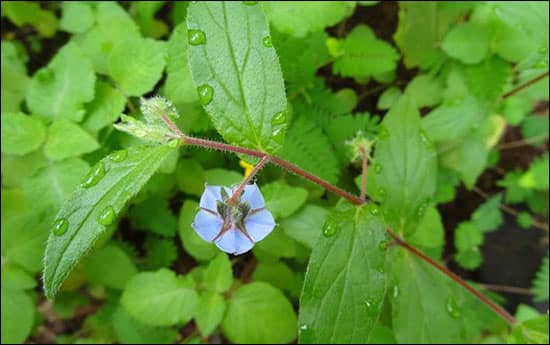
It is an annual, branched, and spreading hairy shrub that grows to a height of 1–13 feet. The leaves are glabrous, oblong to lanceolate, with a glandular texture on the upper surface, measuring 1–3 inches in length. Flowers are bluish, whitish, or with a purplish tinge, about 1 inch in diameter, and characteristically droop downwards. The seeds are ovate, with a shiny grey exterior and brown interior. Flowering generally occurs between September and January, adding ornamental value to its medicinal significance. The plant’s distinct form and seasonal blooming make it easily recognisable in its natural habitat.
Classical Categorisation
- According to Shodala Nighantu – Laxmanadi Varga
- According to Nighantu Adarsha – Shleshmatakadi Varga
Ayurvedic Properties
- Taste (Rasa)– Bitter (Tikta), Pungent (Katu)
- Physical property (Guna) – Light (Laghu)
- Potency (Veerya )- Hot Potency (Usna)
- Post-digestion effect (Vipaka)– Katu (Pungent)
- Effect on tridosha– Balance Vata and Kapha dosha
Therapeutic properties
- Diuretic
- Demulcent
- Anti-inflammatory
- Antimicrobial
- Antioxidant
- Hepatoprotective
- Febrifuge
- Wound healing
- Digestive problems
Systemic Actions
External uses– Possesses analgesic and anti-inflammatory properties. Application of its paste is recommended for joint pain, inflamed wounds, and similar conditions. It is also useful in managing conjunctivitis.
Internal Uses
- Digestive System – Acts as a carminative and absorbent. Beneficial in conditions like loss of appetite, malabsorption syndrome, diarrhoea, and dysentery.
- Circulatory System – Works as a blood purifier and is useful in cases of oedema.
- Excretory System – Promotes increased urine output.
- Reproductive System – Helps contract the uterine muscles. Useful in dysmenorrhea and obstructed labour.
- Satmikarana – It possesses anti-poisonous properties.
- Tapakrama – It is helpful in the management of fever.
- Tvak – Beneficial in various skin disorders.
Chemical Composition
- Steroids
- 1,2-benzenedicarboxylic acid diisooctyl ester
- Triterpenoidal saponins
- Flavonoids
- Linoleic acid
- Oleic acid
- Palmitic acid
- Stearic acid
- Hexacosanol
- Ethyl hexacosanoate
- Ethylester
- 21, 24-Hexacosadienoic acid
- Tannins
- Phenolic compounds
- Reducing sugars
- Alkaloids
- Phytosterols
- Hexacosanoic acid
- Ceryl alcohol
- Ricinoleic acid
- Myristic acid
- Sterculic acid
- n-Decanyl laurate
- n-Tetradecanyl laurate
- n-Nonacosanyl palmitate
- n-Pentacos-9-one
- n-Dotriacont-9-one-13-ene
Modern Overview
Anti-diarrheal activity
The antidiarrheal activity of Trichodesma indicum is attributed to the synergistic action of several bioactive compounds, each working through different mechanisms. Tannins bind to proteins in the intestinal lining, forming a protective layer that reduces fluid secretion and slows intestinal motility, thereby helping to solidify stools. Saponins exhibit antimicrobial effects, targeting diarrhoea-causing pathogens and reducing intestinal irritation. Flavonoids, with their strong antioxidant and anti-inflammatory properties, protect the digestive tract from oxidative stress and inflammation while helping to normalise bowel movement. Phenolic compounds further contribute by providing both antioxidant protection and antimicrobial action, which supports the elimination of harmful microorganisms. Additionally, the ethanol extract of the plant’s root has shown antimicrobial activity against specific pathogens in scientific studies, reinforcing its traditional use. Together, these compounds help control fluid loss, combat microbial infections, and promote intestinal healing, making Trichodesma indicum a valuable natural remedy for diarrhoea.
For Arthritis Management
Trichodesma indicum holds significant potential in the management of arthritis owing to its diverse range of bioactive compounds with strong anti-inflammatory effects. One of its major constituents, 1,2-benzenedicarboxylic acid diisooctyl ester, derived from the plant’s n-hexane extract, plays a crucial role in modulating the body’s inflammatory response. It achieves this by inhibiting key mediators such as TLR-4, TACE, and NIK, which are responsible for initiating and sustaining inflammation in the joints. By blocking these signalling proteins, the compound interrupts the cascade of immune reactions that lead to swelling, pain, and cartilage damage. This action not only alleviates the symptoms of arthritis but also helps protect joint tissues from long-term deterioration. Consequently, Trichodesma indicum emerges as a promising herbal agent for both symptom relief and slowing the progression of arthritic conditions.
Practical uses
- Paste of the whole plant is applied externally to relieve joint pain and swelling in cases of rheumatoid arthritis.
- Fresh juice of Trichodesma indicum (15–20 ml) is administered orally to help manage irritable bowel syndrome and diarrhoea.
- Cold leaf infusion (25–30 ml) of Adha pushpi is taken to reduce burning sensation and ease difficulty during urination.
- Root paste is applied locally to neutralise the effects of snake bites.
- Plant decoction (30–40 ml) is consumed to alleviate menstrual cramps (dysmenorrhea) and in certain cases of abortion for uterine support.
- Root paste is also applied over affected areas to treat various skin infections.
Part used
- Whole plant
- Root
Dosage
- Root paste- 5-10 gm
- Juice of plant- 10-20 ml
Conclusion
Trichodesma indicum is a versatile medicinal plant valued in Ayurveda and folk medicine for its wide range of therapeutic benefits. Its bioactive compounds contribute to properties such as anti-inflammatory, antidiarrheal, diuretic, analgesic, and wound-healing activities. Traditionally, various parts of the plant have been used to manage conditions like joint pain, skin ailments, digestive disorders, urinary problems, and even snake bites. With its accessibility and diverse applications, Trichodesma indicum holds significant potential for both preventive and curative healthcare. Further scientific validation and phytochemical studies can help in developing standardised formulations, ensuring their safe and effective use in modern herbal medicine.
FAQs
1. What are the uses of Trichodesma indicum
Answer– Trichodesma indicum is used in Ayurveda for treating joint pain, swelling, diarrhoea, urinary disorders, skin ailments, and snake bites. It is also valued for its anti-inflammatory, diuretic, and wound-healing properties.
2. Trichodesma indicum belongs to which family?
Answer– It belongs to the Boraginaceae family.
3. What is the Hindi name of Trichodesma indicum
Answer– In Hindi, it is commonly known as Andhahuli.
4. What are the medicinal uses of Trichodesma indicum?
Answer– Medicinally, it is used for rheumatoid arthritis, diarrhoea, urinary burning, fever, skin diseases, wounds, and as a detoxifying herb in snake bites and insect stings.
5. What is the common name of Trichodesma indicum?
Answer– Its common English name is Indian Borage or Indian Viper’s Bugloss.
6. What is the Tamil Name of Trichodesma indicum?
Answer– In Tamil, it is called Vishnu Kiranthi.