The Forest That Forgot to Stop – The Timeless Legacy, Science, and Spirit of the Banyan Tree
Abstract
The Banyan tree (Ficus benghalensis Linn.), known as Vata, Nyagrodha, or Akshaya Vat in Sanskrit, is one of the most revered trees in Indian culture, Ayurveda and spiritual traditions. Unlike ordinary trees, the Banyan continuously extends its life by producing aerial roots that descend to the ground and transform into new trunks, allowing a single tree to expand into an entire grove. This extraordinary characteristic has made it a timeless symbol of immortality, resilience, knowledge, and continuity. In Ayurveda, the Banyan is more than a sacred tree—it is a medicinal treasure. Its bark, aerial roots, leaves, latex, and fruits have been employed for centuries in managing bleeding disorders, wounds, diabetes, female reproductive disorders, oral diseases, and inflammatory conditions. Spiritually, it represents steadfastness and silent wisdom, serving as the seat of Lord Dakshinamurthy, the divine teacher who imparts knowledge without speech. This article explores the Banyan from botanical, Ayurvedic, ecological, medicinal, philosophical, and cultural perspectives, revealing why it continues to inspire generations as one of nature’s greatest masterpieces.
Classical references of Banyan Tree/ Vata / Ficus benghalensis Linn
- Bhavprakash Nighantu Vatadi varga
- Raj Nighantu Amradi varga
Scientific Classification of Banyan Tree/ Vata / Ficus benghalensis Linn
- Kingdom: Plantae
- Subkingdom: Tracheobionta
- Division: Magnoliophyta
- Class: Magnoliopsida
- Order: Rosales
- Family: Moraceae
- Genus: Ficus
- Species: Ficus benghalensis Linn.
Synonym of Banyan Tree/ Vata / Ficus benghalensis Linn
- Bahupada – The tree with many feet; refers to its numerous aerial roots that become supporting trunks.
- Shipharuha – The one whose roots arise from the branches.
- Padarohini – The tree whose roots descend to the ground and establish themselves.
- Pada Rohi – The tree with roots that appear to climb or attach to the stem before reaching the soil.
- Raktaphala – The tree bearing red-colored fruits.
- Ksheeri – The tree that exudes milky white latex.
- Shrungi – The tree with horn-like aerial shoots or roots.
- Vanaspati – A tree with hidden flowers; its flowers are enclosed within the fig and are not externally visible.
- Neela – the dark-coloured tree, referring to its dense foliage or bark.
- Jataala – The tree with numerous hanging aerial roots resembling matted hair.
- Mahachhaya – The tree that provides an extensive area of shade.
- Yakshavasa – The tree believed to be the abode of Yakshas (divine celestial beings).
- Yakshataru – The sacred tree associated with the Yakshas.
- Skandhaja – The tree that produces roots from its branches.
- Skandhajana – The tree that originates new growth from its trunk and branches.
- Nyagrodha – The tree that grows downward through its aerial roots.
- Avarohi – The descending tree, referring to its downward-growing roots.
- Rohini – The ever-growing and continuously regenerating tree.
- Daanta – The firm, stable, and enduring tree.
- Kanchana – The precious or valuable tree.
- Dhruva – The steadfast, permanent, and long-living tree.
- Vaishravana Vasa – The abode of Vaishravana (Kubera), the deity of wealth.
- Vitapi – The extensively branched and widely spreading tree.
- Mandali – The tree with a broad, circular canopy.
- Vanabhu – The glory or ornament of the forest.
Vernacular Names of Banyan Tree/ Vata / Ficus benghalensis Linn
- Hindi: Bad, Bargad, Baragad
- English: Banyan Tree
- Kannada: Alada Mara, Aala, Vatavruksha
- Assamese: Vat, Ahat, Vatgach
- Bengali: Bat, Bat Briksh
- Gujarati: Vad
- Kashmiri: Bad
- Malayalam: Peroal
- Marathi: Vad
- Odia (Oriya): Bata, Bara
- Punjabi: Bhod, Bhaur
- Tamil: Ala
- Telugu: Peddamari
- Urdu: Bad, Bargud
1. The Botanical Architecture of Infinity
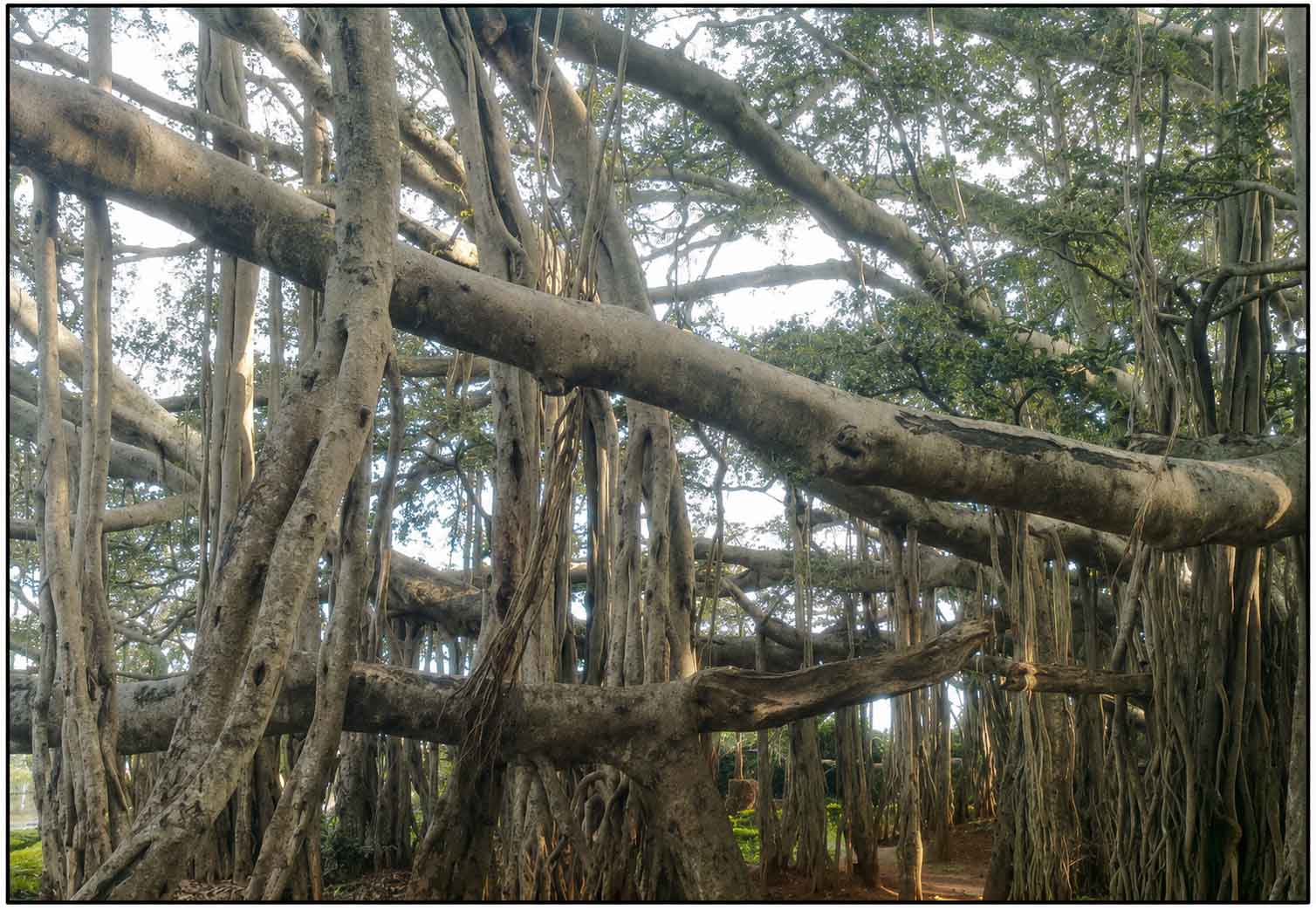
At the heart of the Banyan’s physical mastery is a unique growth mechanism that sets it apart from almost every other flora on the planet. While standard trees follow a linear trajectory—anchoring their roots firmly in the dark earth and sending a solitary trunk upward toward the light—the Banyan operates on a principle of cyclical, multi-directional expansion. The tree begins its life as an epiphyte, often sprouting in the crevices of an older tree, a wall, or a hollow. As it matures, its expansive branches send down delicate, thread-like aerial roots into the open air. Suspended in mid-air, these roots absorb moisture from the atmosphere as they reach toward the ground. The moment these hanging tendrils make contact with the soil, a structural transformation occurs:
- They pierce the hard ground, establishing a secondary, decentralised root system.
- Over decades, these slender lines calcify and expand, turning into massive, pillar-like prop trunks.
- These new trunks pump nutrients back up to the branches, enabling them to extend even further outward.
Through this relentless cycle, a single Banyan tree can eventually span acres of land. It becomes an architectural marvel—a labyrinth of pillars holding up an emerald sky. It is a living forest born from a single seed, defying the traditional limitations of ageing, decay, and environmental stress.
2. Why Is It Called Nyagrodha?
The Sanskrit word Nyagrodha carries a profound etymological and philosophical meaning that captures the tree’s core biological behaviour. In classical linguistics, “Nya” denotes downward movement or direction, while “Grodha” refers explicitly to growth, rising, or expanding. Unlike ordinary trees whose root structures remain entirely concealed beneath the topsoil, the Banyan boldly sends its roots downward from its branches into the open air. These hanging roots eventually become woody pillars supporting the ever-expanding canopy. This distinct downward growth pattern is completely unique among large canopy trees and perfectly explains why ancient Ayurvedic scholars and seers selected the name Nyagrodha. It highlights a philosophy where expansion cannot happen safely without a corresponding return to the earth.
3. The Tree That Refuses to End
Few organisms on Earth embody continuity as beautifully as the Banyan. Its growth pattern functions as an unbroken, self-sustaining loop:
- Every aerial root that reaches the ground develops into another trunk.
- Each new trunk supports additional outward-reaching branches.
- Those branches produce more aerial roots.
- Those roots become additional trunks.
The cycle never truly ends. A Banyan does not simply become older; it becomes larger, stronger, and increasingly self-supporting. In this way, one single seed has the potential to become hundreds of interconnected trunks that function seamlessly as a single living organism. Nature rarely offers a clearer lesson about resilience. Rather than resisting change or succumbing to structural weight, the Banyan transforms growth into stability, making every challenge an opportunity to root itself more deeply.
4. Akshaya Vat: The Sacred Geometry of Eternal Return
Among all sacred trees in Eastern traditions, the Banyan occupies a unique place because it symbolises Akshaya, meaning “that which never diminishes” or “the un-decaying”.
- The Anchor of Prayaga: The famous Akshaya Vat at Prayagraj (Prayaga) has been revered for centuries by pilgrims who believe it represents eternal existence. While its individual branches may age and perish over generations, new trunks continually emerge to sustain the collective canopy. Its immortality is therefore not based upon remaining static or unchanged. Instead, it survives by continually renewing itself from within. This subtle philosophy explains why Indian traditions regard the Banyan as an emblem of life’s endless continuity and cosmic preservation.
- The Thread of Hope: This association with endless renewal is why the Banyan remains a central figure in domestic rituals. Couples seeking children often walk around its massive trunk, tying sacred threads (Mauli) to its bark. This practice reflects profound psychological and spiritual symbolism rather than superstition. Because the Banyan continuously generates new life, its very existence represents fertility, continuity, and hope. Tying the thread is an act of alignment, reminding individuals that patience and deep roots always accompany life’s greatest blessings.
5. The Silent Classroom of Dakshinamurthy
One of the most profound images in Hindu philosophy depicts Lord Shiva as Dakshinamurthy, the primordial guru, seated in absolute peace beneath a Banyan tree.
- The South-Facing Teacher: Unlike other teachers who rely on extensive lectures, complex debates, or written scriptures, Dakshinamurthy remains perfectly silent. He sits facing south, the direction associated with change, ancestors, the unknown, and the unfinished aspects of existence. His disciples sit around him, also immersed in silence, yet deep spiritual wisdom flows effortlessly between them without a single spoken word.
- The Power of Stillness: This imagery communicates an extraordinary truth: not all knowledge comes through language. The deepest understanding emerges only through observation, internal contemplation, and absolute stillness. The Banyan’s calm, immovable presence becomes a core part of the teaching itself. Its vast canopy shelters earnest inquiry, its roots symbolise grounded understanding, and its absolute silence reminds seekers that ultimate truth appears only after the restless mind becomes quiet.
6. The Banyan in Ayurveda
Ayurveda recognises the Banyan as a monumental medicinal treasure (Vanaspati). Nearly every part of the tree—including its bark (Tvak), leaves (Patra), fruits (Phala), milky latex (Kshira), tender buds, and aerial roots (Jata)—possesses therapeutic value. To understand its pharmacological identity, we look directly to the ancient textual authorities preserved in classical Nighantus.
The classical text outlines the fundamental names and immediate physical actions of the Banyan tree as follows
The Banyan tree is known by the names Vata, Raktaphala (bearing red fruits), Shringi, Nyagrodha (growing downwards), Skandhaja (born from branches), Dhruva (eternal/stable), Kshiri (milky/latex-bearing), Vaishravanavasa (abode of Kubera), Bahupada (many-footed), and Vanaspati. Medicinally, Vata is cold (Shita), heavy (Guru), and binding (Grahi). It pacifies Kapha and Pitta doshas, heals wounds (Vrana), improves skin complexion (Varnya), cures herpes or spreading inflammatory skin diseases (Visarpa), quenches burning sensations (Daha), is astringent (Kashaya), and clears female reproductive or uterine disorders (Yonidosha).
(Raj Nighantu Amradi Varga 116-118)
The Banyan tree (Vata, Ficus benghalensis) is known by many names, including Jatala, Nyagrodha, Rohina, Avarohi, Vitapi, Raktaphala, Skandharuha, Mandali, Mahachhaya, Shringi, Yakshavasa, Vakshataru, Padarohini, Neela, Kshiri, Shipharuha, Bahupada, and Vanaspati, each describing its distinctive features such as aerial roots, broad canopy, milky latex, and numerous supporting trunks. It is a majestic tree that provides extensive shade and symbolises longevity and strength. According to Ayurveda, Banyan possesses Kashaya (astringent) and Madhura (sweet) tastes and has Shishira (cooling) potency. It helps balance Kapha and Pitta Doshas and is traditionally used to alleviate fever (Jwara), burning sensation (Daha), excessive thirst (Trishna), mental confusion or faintness (Moha), wounds (Vrana), inflammatory swelling (Shotha), and other disorders associated with aggravated Kapha and Pitta, making it an important medicinal tree in Ayurvedic therapeutics.
The Banyan tree (Vata, Ficus benghalensis) is known by several Sanskrit names such as Raktaphala (bearing reddish fruits), Shringi (having horn-like aerial roots), Nyagrodha (the tree whose roots grow downward), Skandhaja (arising from branches), Dhruva (firm and enduring), Kshiri (yielding milky latex), Vaishravanavasa (the abode of Kubera, the lord of wealth), Bahupada (having many supporting trunks or roots), and Vanaspati (the lord among trees). Ayurveda describes the Banyan as having Sheeta (cooling) potency and Kashaya (astringent) taste, with Stambhana (styptic and tissue-constricting) and Rukshana (drying) properties. It is traditionally used to relieve excessive thirst (Trishna), vomiting (Chardi), fainting (Murchha), and Rakta Pitta (bleeding disorders caused by aggravated Pitta). Its cooling and astringent qualities also help stabilise tissues, reduce excessive secretions, and promote overall balance of Pitta and Kapha Doshas, making it an important medicinal tree in Ayurvedic therapeutics.
Ayurvedic properties of Banyan Tree/ Vata / Ficus benghalensis Linn.
- Taste (Rasa)– Sweet (Madhur), Astringent (Kashaya)
- Physical property (Guna) – Heavy (Guru)
- Potency (Veerya )- Cold Potency (Sheet)
- Effect on tridosha– Balance Pitta and Kapha dosha
Therapeutic Indications of Banyan Tree/ Vata/ Ficus benghalensis Linn.
- Balances Kapha and Pitta Doshas
- Possesses Sheeta Virya (cooling potency) that alleviates excess body heat
- Acts as Grahi (absorbent), helping improve intestinal absorption and reduce excessive bowel movements
- Exhibits Stambhana (styptic) action to control bleeding and excessive discharges
- Has Kashaya (astringent) properties that tighten and strengthen body tissues
- Supports Vrana Ropana (wound healing) by promoting tissue repair
- Enhances Varnya (skin complexion) and maintains healthy skin
- Useful in Visarpa (spreading inflammatory skin disorders) due to its cooling and anti-inflammatory nature
- Relieves Jwara (fever) by pacifying aggravated Pitta
- Reduces Daha (burning sensation) throughout the body
- Alleviates Trishna (excessive thirst) associated with heat disorders
- Helps manage Chardi (vomiting) by calming aggravated Pitta
- Beneficial in Murchha (fainting) by restoring systemic balance
- Helps reduce Shotha (inflammatory swelling and oedema)
- Useful in Rakta Pitta (bleeding disorders) by cooling the blood and controlling haemorrhage
- Supports the management of Yonidosha (female reproductive disorders) through its astringent and tissue-toning properties
- Helps reduce excessive secretions and promotes tissue stability
- Strengthens body tissues and supports natural healing processes
7. A Living Ecosystem: The Keystone Species
To appreciate the Banyan purely as a plant is to miss its grander ecological purpose. In contemporary environmental science, Ficus bengalensis is classified as a vital keystone species—an organism whose presence is foundational to the structural integrity of its native environment. A mature Banyan acts as a complete, self-contained living sanctuary, housing and feeding hundreds of species simultaneously:
- Avian Habitats: Its dense canopy serves as a bustling avian metropolis for crows, pigeons, mynas, and hornbills.
- Insect and Primate Ecosystems: Troops of monkeys leap through its web of prop trunks, while complex colonies of ants, wasps, butterflies, and honeybees live inside its textured bark.
- The Symbiotic Wasp: The reproductive cycle of the Banyan is intimately tied to a specific species of chalcid wasp. The tree provides a safe incubator for the wasp’s larvae inside its closed figs, and in return, the emerging wasps pollinate the tree’s internal flowers.
The tree produces massive quantities of figs throughout the year, sustaining countless animal species during seasons when other food sources are entirely scarce. Furthermore, its extensive network of hundreds of supporting trunks stabilises the topsoil, prevents severe erosion, and conserves localised groundwater tables.
8. The Symbolism of Aerial Roots: Lessons for Human Life
While most trees follow a single upward trajectory away from the earth, the Banyan repeatedly returns to its source. Every single aerial root that drops from its branches reflects a profound philosophical lesson for human development:
- Growth without grounding eventually collapses: No matter how high your branches fly, if you do not send roots back down to the earth, the winds of adversity will topple you.
- Success without humility becomes unstable: True elevation requires a corresponding descent into modesty and self-awareness.
- Knowledge without roots loses direction: To expand outward into the world, we must remain deeply connected to our core values and foundational truths.
The stages of Banyan growth mirror our own human journey. Childhood resembles the single, vulnerable trunk. Adulthood resembles the rapid expansion of outward branches. True elder wisdom, however, resembles the intentional act of returning those branches back to the earth through fresh roots. Life is not a linear march toward a distant finish line; it is a beautiful, circular dance of eternal return where every apparent ending becomes the birthplace of a new beginning.
9. Environmental Importance in Modern Times
In our current era of rapid urbanisation, industrial expansion, and deforestation, ancient Banyan trees are dwindling in numbers. Yet, their presence is more invaluable than ever before. Beyond their immediate cultural and traditional medicine roles, they provide irreplaceable environmental services:
- They act as massive oxygen factories, purifying the air for decades.
- They moderate local microclimates, significantly cooling ambient temperatures beneath their canopy.
- They sequester vast amounts of atmospheric carbon dioxide within their heavy timber trunks.
Conserving these ancient trees means protecting irreplaceable living libraries that have silently witnessed centuries of human civilisation. They are sentinels of biodiversity that cannot be replaced by simply planting modern ornamental lawns.
10. Lessons the Banyan Teaches
The Banyan never competes with nearby trees for dominance; it simply continues its quiet, steady expansion. It never abandons its old, weather-beaten branches; instead, it strengthens them by dropping down a new prop trunk to bear the weight. It never rushes its growth; its legendary greatness emerges gradually over centuries. These intrinsic qualities offer timeless rules for human conduct:
- Patience outlasts speed: Haste creates fragile structures, but patience builds monuments.
- Renewal is stronger than resistance: Rather than breaking against the storm, adapt, drop a new root, and transform change into permanent stability.
- Silence teaches more than noise: True wisdom sits quietly at the center, just as Dakshinamurthy teaches under the unmoving trunk.
11. A Meditation Beneath the Banyan
Imagine sitting quietly beneath its vast, emerald canopy. There is no hurry, no external pressure, and no deadlines. There is only the soft, filtered sunlight dancing through thousands of leaves, while the long aerial roots sway gently in the afternoon breeze. Time slows to an absolute crawl. The Banyan asks no questions and demands no explanations. Its profound message is conveyed simply by its existence: Grow as far and wide as your potential allows, but never lose contact with your roots. Renew yourself whenever life demands it, and allow every hardship to become another solid pillar of strength.
Conclusion
The Banyan (Ficus bengalensis) is far more than an impressive botanical specimen—it is a living blueprint for resilient existence. Revered in classical Ayurveda for its cooling, astringent, and tissue-supportive properties, it has served generations as a valuable medicinal resource. Spiritually, it represents eternal life, silent knowledge, and unwavering faith, embodying the timeless teachings of Lord Dakshinamurthy beneath its expansive canopy. Ecologically, it nurtures countless forms of life, creating entire interconnected ecosystems within a single tree. In every hanging aerial root lies a lesson: setbacks can become structural supports, and every new beginning can strengthen the whole collective. The Banyan reminds us that enduring greatness is built through patience, deep roots, and the quiet courage to keep growing—season after season, generation after generation.