Rohitaka (Tecomella undulata) – Ayurvedic Uses, Properties & Benefits
Abstract
Tecomella undulata Seem., commonly known as Rohida, is a significant medicinal plant native to the arid regions of India. This small deciduous tree has long been revered in traditional Ayurvedic medicine for its multifaceted therapeutic applications. It is known for its hepatoprotective, anti-inflammatory, and antimicrobial properties. It is widely recognised for its ability to thrive in desert climates, and the plant also holds ecological importance in stabilising sand dunes. Its parts are used in various herbal preparations for treating skin disorders, liver ailments, and blood impurities.
Introduction
Rohitaka is a potent Ayurvedic herb known for its broad-spectrum therapeutic efficacy, as described in various classical Ayurvedic texts. Botanically, it is identified as Tecomella undulata (Sm.) Seem. (Bignoniaceae family). It is a deciduous, medium-sized ornamental tree native to the tropical and arid regions of India. This plant is widely recognised in Ayurvedic literature as the authentic source of Rohitaka. Traditionally, it has been extensively used in the treatment of liver and spleen disorders. In addition to hepatosplenic conditions, it is also valued for managing various systemic ailments. Its historical relevance and medicinal importance are well-documented across numerous Ayurvedic Samhitas.
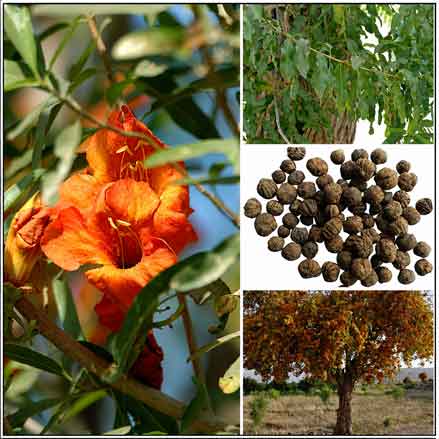
Scientific Classification
- Kingdom: Plantae
- Sub-Kingdom: Tracheobionta
- Division: Magnoliophyta
- Class: Magnoliopsida
- Order: Lamiales
- Family: Bignoniaceae
- Genus: Tecomella
- Species: Tecomella undulata (Sm.) Seem.
Synonyms
- Dadima Pushpa, Dadimaschada – The flowers resemble those of the pomegranate.
- Lohita, Rohita, Raktapushpa – The plant bears red flowers, similar to the colour of blood.
- Kushalmali, Kuta Shalmali – Considered an inferior variety of the Shalmali (Silk Cotton/Bombax ceiba L.) plant.
- Plihagna – Helps in treating disorders related to the spleen.
- Raktaghna – Useful in managing blood-related disorders or vitiation of blood (Rakta Dushti).
- Yaktvairi – Effective in conditions like splenomegaly (enlarged spleen).
- Varatikta – Regarded as one of the best Tikta Dravya (bitter herbs).
- Sadapushpa, Rochana, Sada Prasoona, Parijataka – Names reflecting its ever-blooming nature and beautifying qualities.
Vernacular names
- Hindi: Rugtrora / Rudanti
- English: Desert Teak
- Gujarati: Rohido
- Kannada: Mullumuntala
- Marathi: Rohido
- Malayalam: Cemmaram
- Punjabi: Laberra
- Tamil: Malampuluvan
Habitat
Tecomella undulata is a deciduous or nearly evergreen tree commonly found in arid and semi-arid regions of India. It is recognised by various vernacular names across different Indian languages. In English, it is known as Desert Teak; in Hindi, Rugtrora; in Punjabi, Rohira; in Sindhi, Lohira; in Marathi, Rakhtroda; and in Sanskrit, it is referred to as Rohita. These regional names reflect their widespread traditional recognition and ethnobotanical significance.
Morphology
Tecomella undulata is a large shrub or small tree characterised by drooping branches and greyish-green foliage. It typically grows to a height of 2.5 to 5 meters. The leaves are simple, narrowly oblong, and range from 5 to 12.5 cm in length and 1 to 3.2 cm in width. They are obtuse, entire, and exhibit undulating margins. The flowers are large, attractive, and odourless, typically appearing in shades of orange-red, yellow, or bright red. They are borne in few-flowered corymbose racemes at the ends of short lateral branches. Each pedicle measures about 6 to 13 mm in length. The calyx is campanulate, 9.5 to 11 mm long, with three broadly ovate, mucronate lobes approximately 3 mm long. The corolla is bell-shaped (campanulate), orange-yellow, veined, and measures 3.8 to 6.3 cm in length. It consists of five subequal, rounded lobes. The stamens are exerted with smooth (glabrous) filaments, and the stigma is two-lamellate with spathulate-oblong, rounded lobes. This tree typically blooms between April and May, after which fruiting begins. The fruits are capsules, linear-oblong, slightly curved, and smooth, measuring around 20 cm in length and 1 cm in width. The valves are thin, and the seeds are approximately 2.5 by 1 cm, with narrow wings present only around the apex and absent at the base.
Special Note
There are differences among scholars about Rohitak. Raj Nighantu has considered it to be of two varieties- white and red. Its synonyms – Daadimpushp and Daadimchhad seem to be correct. The leaves and flowers of Tecomella undulata look like pomegranate from a distance. From this point of view, this seems to be the classical Rohitak. Another tree used by the name Rohitak is Amoora rohituka (Amoora rohituka W & A., Syn. Aphanamixis polystachya (Wall.) Parker) (Fam. Meliaceae).
Classical categorisation
- According to Bhavaprakash Nighantu: Classified under Vatadi Varga
- According to Dhanvantari Nighantu: Listed in Amradi Varga
- According to Kaiyadeva Nighantu: Placed under Aushadhi Varga
- According to Raj Nighantu: Categorised in Shalmalyadi Varga
Ancient Verses
रोहीतकः प्लीहघाती रुच्यो रक्तप्रसादनः ॥
(Bhavprakash Nighantu Vatadi varga 35)
According to the above shloka, Rohitaka is effective in the management of spleen related diseases. It helps in improving taste and purify blood.
Ayurvedic properties
- Taste (Rasa)– Bitter (Tikta), Pungent (Katu), Astringent (Kashaya)
- Physical property (Guna) – Light (Laghu), Dry (Ruksha)
- Potency (Veerya )- Cold Potency (Sheet)
- Post-digestion effect (Vipaka)– Katu (Pungent)
- Effect on tridosha– Balance Pitta and Kapha dosha
Therapeutic properties
- Pleeha – Spleen disorders, including splenomegaly
- Udara – Ascites and abdominal enlargement
- Yakrut Roga – Liver diseases and dysfunctions
- Gulma – Abdominal tumours and masses
- Mamsa Meda – Disorders of muscle and adipose (fat) tissues
- Bhuta – Psychiatric conditions; also implies antimicrobial activity
- Anaha – Bloating and sensation of fullness
- Vibandha – Constipation
- Asra – Blood-related disorders, including abscesses, skin issues, menorrhagia, nasal bleeding, etc.
- Shula – Abdominal colic or sharp pain
- Ruja – Generalised pain
- Krimi – Worm infestations (helminthic infections)
- Vrana – Wounds and ulcers
- Netra Roga – Eye diseases
Systemic actions
- External Use- The fresh juice of the plant can be applied in eye disorders and used topically on wounds to promote healing.
Internal Uses
- Digestive System: Acts as a carminative and anthelmintic, and facilitates the normal movement of Vata dosha. It is indicated in conditions such as loss of appetite, low digestive fire (Mandagni), liver disorders, helminthiasis, haemorrhoids, and jaundice.
- Circulatory System: Aids in blood purification. It is beneficial in conditions like rheumatoid arthritis and syphilis.
- Excretory System: Useful in managing diabetes (especially Kapha-Pittaja Prameha) and helps in reducing excessive urine output.
- Satmikarana (Restorative Action): Possesses anti-poisonous properties and is indicated in obesity.
- Reproductive System: Helpful in managing leucorrhea (white vaginal discharge).
Chemical composition
1. Heartwood
- Radermachol
- Lapachol
- Cluytyl frulate
- β-Lapachone
- α-Lapachone
- Dehydro-α-lapachone
2. Leaves
- Cirsimaritin
- Cirsili
3. Bark
- β-Sitosterol
- Iridoid glucosides
- Tecomelloside
- Rutin
- Quercetin
- Betulinic acid
- Luteolin-7-glycoside
4. Root
- Lapachol
- Tricontanol-1
- β-Sitosterol
- Tectol
- Veratric acid
- 6-O-veratryl catalposide
- Quinones
5. Fruit Shell
- Aphanamixin lactone
- Aphanamixolide
6. Seeds
- Tannins (7.14%)
- Seed oil contains: Linoleic acid (53%), Lauric acid
- Kernels yield 44.5% fatty oil
Modern overview
1. Hepatoprotective Activity
Tecomella undulata Seem. exhibits significant hepatoprotective activity due to the synergistic action of its bioactive compounds. Betulinic acid, a triterpenoid found in the stem bark, plays a key role by protecting liver cells from damage induced by toxins like carbon tetrachloride (CCl₄) and enhancing antioxidant enzyme levels in the liver. Iridoid glucosides such as undulatin, tecomelloside, and tecoside further support liver function by reducing inflammation and promoting tissue regeneration. Ferulic esters, including octacosanylacetylferulate and octacosanylferulate, contribute by stabilising cell membranes and preventing oxidative stress. Additionally, naphthaquinone derivatives, phytosterols, and flavonoid glycosides enhance detoxification pathways and exhibit anti-inflammatory and antioxidant effects. Together, these constituents work to reduce hepatic inflammation, combat oxidative damage, and support liver cell repair, making Tecomella undulata a valuable herb in managing liver disorders.
2. Splenoprotective Activity
Tecomella undulata, commonly known as desert teak, exerts therapeutic effects on spleen disorders, particularly splenomegaly, through the action of its key phytoconstituents. Stigmasterol and β-sitosterol, two prominent phytosterols, possess strong anti-inflammatory and immunomodulatory properties that help reduce spleen enlargement and restore normal function. Lapachol, a naphthoquinone derivative, offers antimicrobial and anticancer benefits, potentially targeting infections or abnormal cellular growth contributing to spleen pathology. Tectol supports spleen health through its antioxidant activity, protecting splenic tissue from oxidative damage. Additionally, flavonoids such as rutin, quercetin, and luteolin-7-glycoside further aid in reducing inflammation and shielding the spleen from free radical-induced stress. Together, these compounds enhance spleen function by reducing inflammation, promoting cellular repair, and combating underlying microbial or oxidative insults.
3. Blood Purification Activity
Tecomella undulata (Rohitaka) supports blood purification through the synergistic action of its bioactive compounds. Lapachol, a naphthoquinone derivative, exhibits potent anti-inflammatory and antioxidant effects, helping to eliminate toxins and reduce oxidative stress in the bloodstream. β-Sitosterol, a phytosterol present in the bark, leaves, and flowers, contributes by lowering cholesterol levels and modulating inflammation, which indirectly promotes cleaner blood circulation. Flavonoids such as rutin, quercetin, and luteolin-7-glucoside offer strong free radical-scavenging and anti-inflammatory actions, helping to protect blood vessels and purify the blood. In addition, triterpenoids, iridoid glucosides, and other phytoconstituents enhance liver function and detoxification, further aiding the removal of impurities from the bloodstream. Collectively, these compounds help restore the balance of blood components and improve overall circulatory health.
Practical uses
- For skin disorders, a decoction prepared from the bark is used for bathing to cleanse and soothe the affected skin.
- For leucorrhea, a paste made from the bark and root is mixed with honey and administered in a dose of 3–5 grams.
- To manage spleen-related disorders such as splenomegaly, a bark decoction is taken orally in a dose of 40–50 ml.
- For diabetes and jaundice, a decoction of the heartwood is consumed regularly to support liver and metabolic function.
- In cases of indigestion, loss of appetite, and intestinal worm infestation, bark powder is given in a dose of 3–4 grams.
- For treating piles and splenomegaly, cow urine or water infused with the powder of Rohitaka and Haritaki is taken internally to alleviate symptoms effectively.
Part used
- Bark
Dosage
- Bark powder- 1-3 gms
- Decoction- 50-100ml
Ayurvedic Medicines
- Rohitakarisht
- Rohitakadya Churna
- Rohitaka Ghrit
- Rohitak Loha
Planet Ayurveda Medicines
- Spleen Detox Capsules
- Livo Plan Syrup
- Kalmeghasav
- Zigr Vet Syrup
Conclusion
Tecomella undulata is a time-honoured medicinal plant revered for its potent therapeutic actions, especially in liver and spleen ailments. Its role in traditional medicine is well-established, and modern research continues to validate its efficacy. Besides its medicinal benefits, it plays a vital ecological role in desert conservation. With rising interest in herbal remedies, Tecomella undulata deserves greater attention in both Ayurvedic and modern phytotherapeutic studies.