Pleomorphic Adenoma – Symptoms, Causes & Management
Abstract
Salivary gland tumors are abnormal growths that develop in the major or minor salivary glands, which are responsible for producing saliva to aid digestion and maintain oral health. These tumors can be benign or malignant, with benign tumors being more common and typically slow-growing, while malignant tumors may be aggressive, invasive, and capable of spreading to surrounding tissues. Patients may present with swelling, pain, difficulty in chewing, facial asymmetry, or numbness depending on the tumor’s location and size. Early diagnosis through clinical evaluation, imaging, and cytology is crucial for effective management. Among benign salivary gland tumors, pleomorphic adenoma is the most frequently occurring type, known for its slow growth and mixed cellular composition. In this article, we shall discuss more about Pleomorphic adenoma and its management.
Introduction
Pleomorphic adenoma is a benign epithelial tumor originating from salivary gland tissue, known for its histological diversity, hence the term “pleomorphic.” The tumor consists of epithelial, myoepithelial, and mesenchymal-like components arranged in various patterns. It commonly affects adults between the third and sixth decades of life and shows a slight female predominance. Despite its benign nature, the tumor is clinically significant due to its tendency for recurrence and its ability to undergo malignant transformation if left untreated for long durations.
Causes
The exact cause of pleomorphic adenoma remains unclear, but several contributing factors have been proposed that are given below :
- Genetic alterations, particularly involving chromosomal rearrangements affecting PLAG1 and HMGA2 genes, play a significant role in tumor development.
- Prior exposure to radiation in the head and neck region has also been associated with increased risk.
- Hormonal influences and long-standing irritation of salivary gland tissue may act as promoting factors.
However, no single causative factor has been definitively established.
Signs and Symptoms
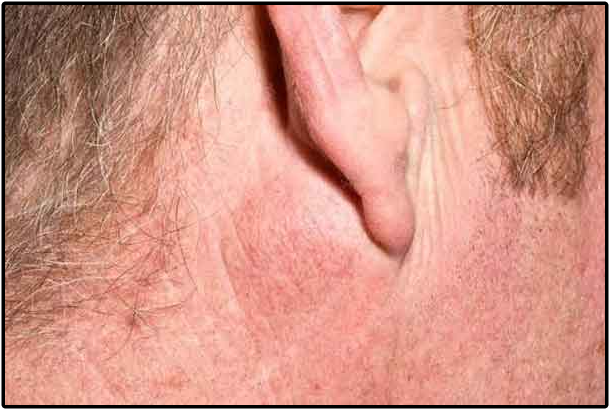
- Pleomorphic adenoma typically presents as a slow-growing, painless, firm mass in the region of the affected salivary gland.
- When involving the parotid gland, it appears as a well-defined swelling near the angle of the jaw or in front of the ear.
- Tumors arising from minor salivary glands often present as nodular swellings on the palate or inner cheek.
- Facial nerve function is usually preserved, and pain or ulceration is uncommon unless malignant transformation occurs.
- Long-standing lesions may show rapid enlargement, hardness, or fixation, raising suspicion of malignancy.
Investigation
- Clinical examination forms the initial step in diagnosis, focusing on size, consistency, mobility, and involvement of adjacent structures.
- Imaging studies such as ultrasonography help differentiate solid from cystic lesions. Magnetic resonance imaging (MRI) is preferred for assessing tumor extent, capsule integrity, and relation to surrounding tissues.
- Fine-needle aspiration cytology (FNAC) is a valuable diagnostic tool, providing preoperative confirmation with high accuracy.
- Histopathological examination.
Management
- Surgical excision is the treatment of choice for pleomorphic adenoma.
- In parotid gland tumors, superficial or total parotidectomy is performed with careful preservation of the facial nerve.
- Radiotherapy is generally not indicated for benign cases but may be considered in recurrent or inoperable situations.
Ayurvedic Correlation and Management
From an Ayurvedic view, pleomorphic adenoma can be correlated with Kaphaja Arbuda, conditions characterized by localized, firm swellings arising due to vitiation of Kapha Dosha, along with involvement of Meda, Mamsa, and Rakta Dhatu. The slow growth, painless nature, and firm consistency of the tumor reflect Kapha dominance, while chronicity suggests deep-seated dosha vitiation. Ayurvedic management focuses on purification therapies first. Then it should be followed by bloodletting, poultice application and medicated pastes and krimi therapy (maggot), after that kshar karma, agni karma (thermal cautery) or sastra karma (surgical excision) is indicated and herbal washing of the wound is advised. Shamana therapy includes the use of Kapha-pacifying herbs known for their Lekhana (scraping), Shothahara (anti-inflammatory), and Granthi-nashaka (anti-tumor) properties. Dietary regulation emphasizing light, warm, and easily digestible foods is advised, while heavy, oily, and cold foods are avoided. Lifestyle measures aim at improving Agni (digestive fire) and reducing Ama (metabolic toxins)
Herbal Remedies by Planet Ayurveda for Pleomorphic Adenoma
Planet Ayurveda is a well-known Ayurvedic healthcare brand focused on promoting natural wellness through authentic herbal formulations. Inspired by classical Ayurvedic texts, the company develops plant-based supplements and care packs designed to support overall health. Planet Ayurveda emphasizes purity, safety, and quality by using carefully sourced herbs and modern manufacturing standards. Its wide product range addresses various health concerns while encouraging a holistic approach to healing. By blending traditional Ayurvedic wisdom with contemporary quality control, Planet Ayurveda offers reliable natural solutions for balanced health and long-term well-being. Planet Ayurveda is pleased to inform the general public about its list of products for the management of Pleomorphic adenoma.
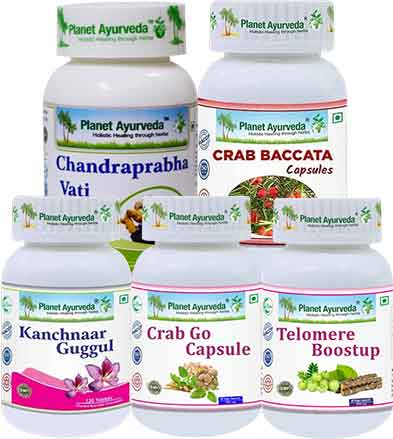
Product list
- Kanchnaar Guggul
- Crab Baccata Capsules
- Crab Go Capsules
- Telomere Boostup
- Chandraprabha Vati

Product Description
1. Kanchnaar Guggul
Kanchnaar Guggul is a classical ayurvedic medicine useful in targeting the uncontrolled growths. Kanchnaar (Bauhinia variegata) possesses Granthi-hara and Lekhana (scraping) properties that help reduce abnormal tissue proliferation, while Guggul (Commiphora mukul) supports Kapha clearance, improves microcirculation, and aids in resolving chronic swellings. The presence of Trikatu (three herbs) enhances Agni (digestion), facilitating Ama pachana (endoxin clearance) and preventing further accumulation of metabolic toxins that contribute to tumor chronicity. Together, these actions help regulate Kapha dosha, support lymphatic detoxification, and maintain tissue metabolism. Thus, Kanchnaar Guggul acts as a supportive herbal formulation helping reduce recurrence risk and promoting systemic balance.
Dosage : Two tablets twice a day.
2. Crab Baccata Capsules
Planet Ayurveda’s Crab Baccata Capsules is formulated from a standardized extract of Taxus baccata (Thuner), a plant valued for its anti-inflammatory (Shothaghana) properties and ability to assist in managing chronic abnormal growths and malignant-type inflammation in the body. The active compound paclitaxel (taxol) found in Taxus baccata exhibits cytotoxic effects and promotes apoptosis, meaning it can help regulate abnormal cell proliferation and support healthy cell function. By helping to modulate abnormal cellular activity and supporting systemic balance, these capsules complement conventional management by reducing inflammation and promoting healthier tissue as part of a broader integrative approach. Hence, these capsules are of great help in the management of Pleomorphic adenoma.
Dosage : One capsule twice a day.
3. Crab Go Capsules
Planet Ayurveda’s Crab Go Capsules are helpful in the management of pleomorphic adenoma by addressing abnormal tissue overgrowth and chronic inflammation. These capsules are formulated with standardized extracts of herbs such as Ashwagandha (Withania somnifera), Shatavari (Asparagus racemosus), Haridra (Curcuma longa), Giloy (Tinospora cordifolia), Tulsi (Ocimum tenuiflorum), and others, which together possess anti-inflammatory, antioxidant, immunomodulatory, and cytoprotective properties. This herbal blend helps reduce oxidative stress and free radical production, supports immune balance, and assists in managing conditions related to abnormal growths, whether cancerous or non-cancerous, by promoting healthier cell function and reducing chronic inflammation. Such actions align with the goal of reducing Kapha aggravation and Ama (endotoxins), offering a supportive role alongside management for pleomorphic adenoma.
Dosage : Two capsules twice a day.
4. Telomere Boostup
Telomere Boostup is a product of Planet Ayurveda and helps regulate cellular aging and genetic stability, which is relevant because genetic alterations play a contributory role in the development of this tumor. Pleomorphic adenoma is associated with chromosomal rearrangements and abnormal cellular proliferation, and telomere dysfunction is known to influence genomic instability and uncontrolled cell division. Telomere Boostup contains Rasayana herbs such as Amalaki (Emblica officinalis), Ashwagandha (Withania somnifera), Giloy (Tinospora cordifolia), and grape seed extract, which are rich in antioxidants and are known to support telomere length maintenance, DNA protection, and cellular repair mechanisms. By reducing oxidative stress and improving telomerase regulation, the formulation helps protect chromosomes from premature shortening, thereby supporting controlled cell replication. Thus, Telomere Boostup acts as a supportive adjunct in the management, helping reduce genetic instability and supporting long-term tissue health.
Dosage : One capsule twice a day.
5. Chandraprabha Vati
Chandraprabha Vati is a classical ayurvedic formulation contains herbs and minerals known for their deep detoxifying, anti‑inflammatory, and Kapha‑balancing properties, which help reduce Ama (metabolic toxins), improve microcirculation, and support healthy tissue metabolism. The formulation contains shilajit (Asphaltum), Guggul (Commiphora mikil), Vacha (Acorus calamus), Vidanga (Embelia ribes), Guduchi (Tinospora cordifolia), Maricha (Piper nigrum), Pippali (Piper longum), Shunthi (Zingiber officinalis) and others. In pleomorphic adenoma, metabolic dysregulation contributes to abnormal cell proliferation, and Chandraprabha Vati helps enhance digestive fire (Agni) and systemic detoxification and corrects the metabolism and prevents uncontrolled cellular multiplication. Chandraprabha Vati serves as a supportive adjunct to improve overall metabolic balance and assist in preventing recurrence.
Dosage : Two tablets twice a day.
Conclusion
Pleomorphic adenoma is a common benign tumor of the salivary glands that, despite its slow growth and painless nature, carries a risk of recurrence and potential malignant transformation if not managed appropriately. Early diagnosis through clinical examination, imaging, and cytology, followed by complete surgical excision, remains the definitive treatment. From an Ayurvedic perspective, the condition correlates with Kapha-dominant Arbuda, requiring an approach that combines purification therapies, local interventions, and Kapha‑pacifying Shamana treatments. Planet Ayurveda’s herbal formulations provide additional support by reducing inflammation, regulating cellular proliferation, correcting metabolic imbalances, and maintaining genetic and tissue health. Together, modern approaches and Ayurvedic supportive care offer a comprehensive strategy to manage pleomorphic adenoma effectively, minimize recurrence, and promote healthy well being.