Sagona (Indian Teak) – Tectona grandis Benefits, Uses & Ayurvedic Properties
Abstract
Teak (Tectona grandis Linn.), a deciduous tree belonging to the Lamiaceae family, is globally valued for its exceptional-quality timber, renowned for its durability and natural resistance to decay, pests, and extreme environmental conditions. It is native to tropical regions. Teak is now extensively cultivated across Southeast Asia, Africa, and the Pacific Islands. Its remarkable characteristics have made it a vital resource across multiple industries, including traditional medicine, cosmetics, and food. In addition to its timber, Teak yields a variety of bioactive compounds, such as flavonoids, phenolics, and terpenes, that exhibit potent antioxidant, antimicrobial, and anti-inflammatory activities. Let’s study in detail!
Introduction
Tectona grandis Linn. (Teak), locally known as Sagwan or Sagon, belongs to the Lamiaceae (formerly Verbenaceae) family and is among the most valued timber-producing plants globally. Teak is widely recognised not only for its commercial importance but also for its rich phytochemical profile. The tree is a source of numerous bioactive compounds, including tectoquinone, lapachol, and deoxylapachol, which contribute to its diverse pharmacological actions. It contains abundant metabolites such as naphthoquinones, anthraquinones, and isoprenoid quinones, along with triterpenoids, flavonoids, steroids, lignans, fatty esters, tannins, proteins, resins, diterpenes, phenolic compounds, and natural pigments. Teak plays a significant role in traditional medicine due to its wide-ranging therapeutic potential. Pharmacological studies have demonstrated its antioxidant, antiarthritic, cytotoxic, antidiabetic, anti-tyrosinase, antinociceptive, anti-termitic, antipyretic, hypoglycemic, wound-healing, antiplasmodial, analgesic, hair growth-promoting, and allelopathic activities.
Scientific Classification
- Kingdom: Plantae
- Subkingdom: Tracheobionta
- Division: Magnoliophyta
- Class: Magnoliopsida
- Order: Lamiales
- Family: Lamiaceae
- Genus: Tectona
- Species: Tectona grandis L.f.
Synonyms
- Kharachada – its leaves are rough in texture.
- Bhumisaha – its wood endures and remains strong for a long time.
- Saaka – the wood is capable of bearing heavy loads; hence, it is strong and durable.
- Gruhadruma – it is a tree used extensively for making household items and furniture.
- Sthirasaara – its heartwood is solid, stable, and firm.
- Bruhatchada –the plant has broad and rough leaves.
- Dwaradaru
- Varadaru
Vernacular names
- Burmese: Kyun
- English: Teak wood, Indian oak, Teak tree
- Filipino: Dalanang, Djati
- French: Teck
- German: Tiek, Teak(hölz)baum
- Gujarati: Sagach, Saga
- Hindi: Saigun, Sagwan, Sagun
- Indonesian: Kulidawa, Deleg, Jati
- Italian: Teck
- Javanese: Deleg, Kulidawa
- Malay: Jati
- Nepali: Teak, Saguan
- Sanskrit: Bardaru, Bhumisaha, Saka, Dwardaru, Kharchchad
- Sinhala: Takku, Teaku
- Spanish: Teca
- Swahili: Msaji, Mtiki
- Tamil: Tekku, Tekkumaram, Tek
- Thai: Sak, Mai-sak
- Trade Name: Teak
- Bengali: Segun, Saigun
Habitat
It is Native to Peninsular India and Madhya Pradesh. Tectona grandis is also found across various regions, including parts of Rajasthan, southern Uttar Pradesh, Odisha, Assam, Bihar, Maharashtra, Andhra Pradesh, Tamil Nadu, Karnataka, and Kerala.
Morphology
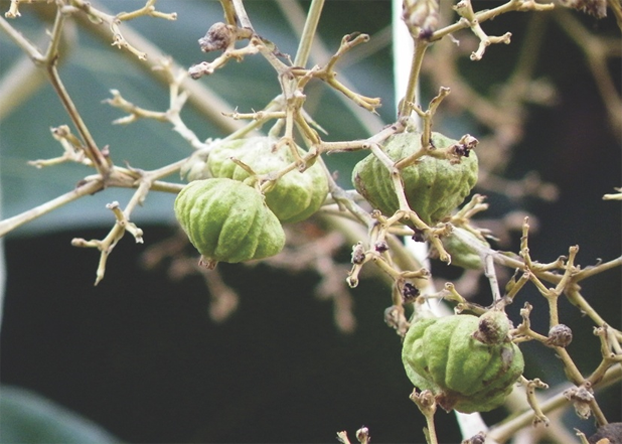
Teak (Tectona grandis) is a tall deciduous tree native to tropical regions, capable of reaching heights of 30 to 40 meters. It features a straight, cylindrical trunk that is often free of branches for a considerable length, topped with a broad, rounded crown. The bark is grayish-brown and may appear smooth or flake off in patches. Its leaves are large, opposite, and ovate in shape, measuring approximately 30–60 cm in length and 20–40 cm in width. They have a rough texture, with clearly visible veins and a hairy underside. Teak trees typically shed their leaves during the dry season. The tree blooms during the rainy season, producing small, white to pale lilac flowers arranged in large terminal panicles. These bisexual flowers have tubular, five-lobed corollas. The fruit is a round drupe, enclosed in a papery, four-lobed calyx, and contains a hard seed that aids in reproduction. Teak is especially valued for its high-quality, golden-brown timber, which is naturally resistant to termites, decay, and moisture. The presence of natural oils in the wood gives it a smooth, lustrous finish, making it ideal for construction and fine woodworking.
Classical categorisation
- According to Dhanvantari Nighantu – Amradi Varga
- According to Kaiyadeva Nighantu – Aushadhi Varga
- According to Abhidhana Ratnamala – Kasayadravya Varga
- According to Nigantu Adarsha – Nirguntyadi Varga
- According to Priya Nighantu – Saradi Varga
- According to Madanapala Nighantu – Vatadi Varga
- According to Saaligrama Nighantu – Phala Varga
- According to Bhavaprakash Nighantu – Vatadi Varga
- According to Raj Nighantu – Prabhadradi Varga
- In Sushruta Samhita:
Shakapatra (Teak leaf) is mentioned among the Anushastras (secondary surgical tools).
Shakaphala (Teak fruit) is included in the Parushakaityadi Gana.
Referenced in Masanumasika Karma in Sharira Sthana (monthly regimen during pregnancy). - In Ashtanga Hridaya: Shaka is listed under the Parushakadi Gana (a group of sweet and nourishing fruits).
Ancient Verses
According to the above Shloka, Sagona has cold potency and is effective in the management of bleeding disorders
Ayurvedic properties
- Taste (Rasa)– Astringent (Kashaya)
- Physical property (Guna) – Light (Laghu), Dry (Ruksha)
- Potency (Veerya )- Cold Potency (Sheet)
- Post-digestion effect (Vipaka)– Katu (Pungent)
- Effect on tridosha– Balance Pitta and Kapha dosha. Seeds balance Vata dosha.
Therapeutic properties
- Antimicrobial
- Anti-inflammatory
- Antioxidant
- Wound-healing
- Antidiabetic
- Hepatoprotective
- Neuroprotective
- Anthelmintic
- Laxative
- Diuretic
- Expectorant
- Febrifuge
- Analgesic
- Cytotoxic
- Antiallergic
- Antiplasmodial
- Antitussive
- Antipyretic
- Antirheumatic
- Antiseptic
Systemic actions
- External– Paste of its powder is very effective and useful in the management of inflammation, burning sensation and headache. Leaf juice is used in the management of injuries.
Internal uses
- Digestive System- It is effective in the management of acidity, worm infestation and dysentery.
- Reproductive System– Its decoction is useful in the management of miscarriage and leucorrhea.
- Urinary System- Bark decoction is really beneficial in the management of diabetes.
Chemical composition
1. Wood
- Resin
- Silica
- Calcium phosphate
- Ammonium phosphate
- Magnesium phosphate
- Anthraquinone-2-carboxylic acid
- Anthraquinone-2-carboxaldehyde
- Triterpenic and hemiterpenic compounds
- 9,10-dimethoxy-2-methyl-1,4-anthraquinone
- 5-hydroxy-2-methyl-9,10-anthraquinone
- 1-hydroxy-5-methoxy-2-methyl-9,10-anthraquinone
- 1,5-dihydroxy-2-methyl-9,10-anthraquinone
- Tectoquinone
- Tectomarubiginone-I(I)
- Dehydro-α-lapachone
- Lapachol
- 5-hydroxy-lapachol
- Methylquinizarin
- Squalene
- Dehydro-α-isodunione
- Lignins
2. Root
- Lapachol
- Tectol(II)
- Dehydrotectol
- Tectonoquinone
- β-lapachone
- Dehydro-α-lapachone
- Β-sitosterol
- New diterpene
- Tectograndonol(III)
- Non-structural carbohydrates
- 1-hydroxy-2-methyl anthraquinone
- Pachy Basin
- Obtusifoliin
- Betulinic acid
- Tectoleaf Quinone
3. Leaves
- Tectoleaf Quinone
4. Seed
- Tannins (6%)
- Dye
- Tectoinols-B(IV), Tectoinols-A(V)
- Monoterpenes
- Apocarotenoids
- Protein (7.1%)
- Crude fiber (22.3%)
- Calcium (3%)
- Phosphorus (0.46%)
- Squalene
- Polyisoprene-o-tolylmethyl ether
- Betulinic acid
- Napthaquinone pigment
- Tectograndon
5. Bark
- Tannin (7.14%)
- 5-hydroxy-1,4-naphthalenedione (Juglone)(VI)
- Obtusifoliin(VII)
- Desidro-α-lapachon(VIII)
- Endophytic compounds
- Gallic acid
- Ferulic acid
- Caffeic acid
- Tectochinon(IX)
- 2-hydroxy methyl-anthrachinon
- Hydroxyl lapachol(X)
- Deoxy Lapachol
6. Other Constituents
- Colour components (25.88%)
- Heavy metals (27)
- Ral (2.93%)
Modern overview
1. Hemostatic Activity
Teak (Tectona grandis) contains several phytochemicals that may offer potential benefits in the management of bleeding disorders. Notably, lapachol and deoxylapachol (naphthoquinones) found in teak are believed to support hemostatic activity by promoting platelet aggregation and enhancing blood clot formation, which can help control excessive bleeding. These compounds also possess anti-inflammatory and antimicrobial properties that aid in preventing infection and promoting wound healing at the site of injury. Tectoquinone, another naphthoquinone present in teak, may contribute to stabilising damaged blood vessels and supporting tissue regeneration. Additionally, the presence of triterpenoids and phenolic compounds provides antioxidant effects and may strengthen vascular integrity. Altogether, these bioactive components make teak a promising natural aid in reducing bleeding tendencies and accelerating recovery in bleeding disorders, although further clinical research is needed to confirm these effects.
2. Anti-cancer activity
Tectona grandis (teak) possesses several bioactive compounds with potential anticancer properties, including lapachol, tectoquinone, quercetin, gallic acid, and ferulic acid. Lapachol, a naphthoquinone derivative, has demonstrated anti-tumour activity by inducing apoptosis (programmed cell death) and inhibiting the growth of cancer cells in preclinical studies. Tectoquinone, another naphthoquinone, has shown cytotoxic effects, particularly through the disruption of cancer cell membranes and inhibition of cell proliferation. Quercetin, a powerful flavonoid found in teak, is noted for its ability to suppress tumour growth, especially in breast cancer, and may act as a Matrix Metalloproteinase-9 (MMP-9) inhibitor, which prevents tumour invasion and metastasis. Additionally, gallic acid and ferulic acid contribute antioxidant and anti-inflammatory actions that support overall anticancer defence. These compounds collectively interfere with various stages of cancer development, making teak a promising candidate for further research in cancer therapeutics.
Practical uses
- Vibandha (Constipation): Fresh juice of the bark is administered orally twice daily.
- Udarashoola (Abdominal pain): Powder of the stem bark is taken orally.
- Netra Shotha (Swollen eyelids): Ash of the wood is applied externally on the eyelids.
- Mutrakrichra (Difficulty in urination): Seeds are boiled in water to prepare a decoction (kwath), and half a cup is given twice a day for seven days.
- Mukha Roga (Oral disorders): Juice of the stem is applied locally in the mouth.
- Daha (Burning sensation): Paste of the bark is administered orally.
- Sprain: Stem bark paste prepared with oil is applied externally on the affected area.
- Atisara (Diarrhoea): Powder of the stem bark is administered orally.
- Type II Diabetes: Take 2–3 g of leaf powder (from shade-dried mature leaves) early morning daily.
- Uncontrolled Urination / Diabetes: Prepare a decoction using 10 g of dried bark and consume daily.
- Burns & Scalp Blisters: Crush 20–25 tender leaf buds, cook with 100 ml oil + 200 ml water to make oil; apply externally.
- Urinary Calculi: Make a decoction of 10 g powdered dry seeds; take 50–60 ml twice or thrice daily.
Part used
- Flower
- Seeds
- Stem bark
- Leaves
Dosage
- Bark powder- 3-12 gms
- Decoction- 50-100 ml
Conclusion
Tectona grandis is not only a symbol of strength and utility in the timber industry but also a reservoir of medicinal properties in traditional medicine. Its use in treating various ailments, especially skin and inflammatory conditions, highlights its therapeutic relevance. With a rich chemical profile and time-tested efficacy, it stands as a valuable plant in Ayurvedic pharmacopoeia. Continued pharmacological studies may further validate and enhance its role in integrative medicine.