Acute flaccid myelitis – Definition, symptoms, causes, and treatment
Abstract
The Central Nervous System is the master control system of the body. It receives information from all sense organs, processes it, and sends commands to different body parts. Any disease affecting the brain or spinal cord can produce severe symptoms which include movement issues, memory problems, paralysis, behavioral changes, seizures or loss of consciousness. So now we will discuss a rare condition that affects the central nervous system and particularly the spinal cord and that is Acute Flaccid Myelitis.
Introduction
Acute Flaccid Myelitis or AFM is a rare and serious neurological condition which involves the inflammation of the gray matter of the spinal cord that leads to the sudden weakness of limbs, loss of reflexes and loss of muscle tone and it generally follows a viral infection. It generally affects the children and although it is similar to poliomyelitis, it is associated with the enterovirus illness and mainly EV- D68 strain is involved. It resembles the symptoms of Guillain Barre Syndrome, infectious myelitis, demyelination, etc. but is entirely different from them in pathophysiology, clinical course and diagnostic results.

Causes
It is primarily caused by viral infections, especially enterovirus (like EV-D68, EV-A71) infections. Along with EV-D68 virus, there are other viruses that may cause acute flaccid myelitis are adenovirus, Epstein Barr virus, human herpesvirus.
Pathophysiology
The exact mechanism of how this disease occurs is not known, it involves a complex mechanism between virus and immune response. Enterovirus mostly causes respiratory illness but it may also spread to the spinal cord due to its ability to assess the nervous system and its capability to infect neurons. The viral infection triggers the immune response which damages the anterior horn motor neurons in the spinal cord which disrupts the transmission of nerve signals to muscles. This damage can be extensive and irreversible and can lead to long-term disability.
Clinical Features
Its clinical course can be divided into different stages:
- Prodromal phase: The disease starts with fever and respiratory symptoms like cough, rhinitis, sore throat, etc. Patients may also have lesions in mouth, hand or foot and may also be associated with vomiting or diarrhoea.
- Acute phase: The onset of neurological symptoms is rapid and may progress within hours to a few days. There is pain in the affected limb before the actual weakness. The weakness is flaccid and asymmetric. Upper limbs and proximal muscle groups are mainly involved than the lower limbs and distal muscle groups. This eventually leads to atrophy of affected limb muscle and resulting in complete paralysis. There are some associated symptoms like neck stiffness, difficulty in speaking and swallowing, bowel-bladder dysfunction or altered mental status.
- Convalescent phase: In this stage, patients may experience persistent weakness, atrophy , deformities and may have complications like decreased bone mineral density, fractures, or dislocations.
Diagnosis
- Clinical examination of patient
- Nasopharyngeal/oropharyngeal/ rectal swabs to look for Enterovirus D68 virus.
- Lumbar puncture for CSF analysis
- MRI Spinal Cord to look for lesions and inflammation in spinal cord
- Electrophysiology is nerve conduction studies to assess nerve/muscle function.
Modern Treatment
As there is no specific treatment protocol for this. The management of AFM is primarily supportive and focuses on stabilizing the patient through cardiovascular monitoring, addressing autonomic and bowel dysfunctions, ensuring effective pain control and providing measures to prevent thromboembolism and pressure ulcers.
Ayurvedic Overview
Although Acute Flaccid Myelitis (AFM) has no direct reference in classical Ayurvedic texts, it is observed that as it occurs due to viral infections and primarily involvement of the nervous system, it can be understood as a Vata Vyadhi which is triggered by Agantuka Hetu (external factors). Agantuka hetu (External factors) as per ayurveda include krimi or bhuta (it includes all types of microbes that can cause infections), abhighata (trauma), etc. These factors lead to the Dosha imbalance particularly the Vata Dosha Imbalance which leads to the symptoms according to the place where it lodges (Sthaansamshraya). When this vata lodges in the spinal cord it leads to symptoms like balakshaya (loss of strength), Anga Shaithilya (flaccidity), Anavasthita Cheshta (impaired voluntary movement), Vag-vaikalyata (unable to speech properly), etc.
The best treatment to manage conditions due to Vata Dosha is Basti (Enema Therapy). It can be done either internal (enema of medicated oils or decoction) or external (locally in the form of Kati Basti, Griva Basti or Prishtha Basti). Nasya (instillation of medicines through nasal route), Murdhini tail (Oil therapies done on head which includes shirodhara, shirobasti, etc.), Abhyanga (massage with medicated oils), Swedena (fomentation), Upanaha (Medicinal poultice) etc. are also helpful to balance Vata Dosha and provide strength to the weakened muscles.
Various herbs that are used in acute flaccid myelitis are Eranda (Ricinus communis), Nirgundi (Vitex negundo), Ashwagandha (Withania somnifera), Bala (Sida cordifolia), Rasna (Pluchea lanceolata), etc. These herbs help to calm the aggravated vata dosha and also helps to nourish the neurons and the spinal cord.
There are various formulations that are very helpful in this. These are:
- Dashmoolarishtam
- Brihat vatachintamani rasa
- Maharasnadi kashayam
- Yograj guggulu
- Dhanwantram taila
- Gandharavhastadi kashayam
- Ekangveera rasa
- Ksheerbala taila
Diet and lifestyle to follow in Acute Flaccid Myelitis
- Eat warm, soft, and easily digestible foods like khichdi, porridge, and soups.
- Avoid cold, dry, raw, processed, and junk foods.
- Perform daily warm oil massage with oils like Dhanwantram oil, Mahanarayan or sesame oil
- Maintain regular sleep patterns and avoid overexertion.
- Daily gentle physiotherapy and passive stretching exercises.
Herbal Remedies for Acute flaccid Myelitis by Planet Ayurveda
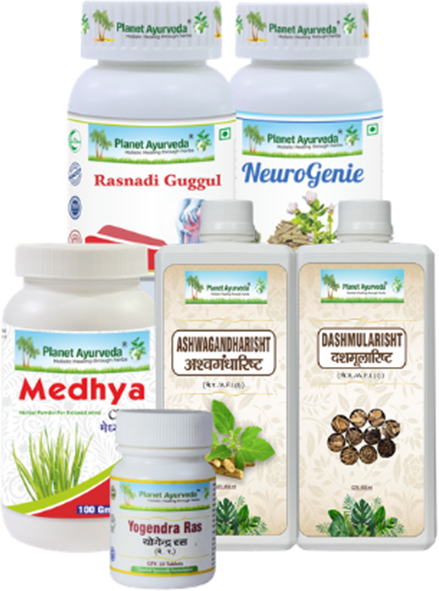

Planet Ayurveda is a reputed Ayurvedic company that specializes in offering herbal products formulated according to traditional Ayurvedic principles. Each product is made from pure herbs, free from additives or chemicals, ensuring safety and efficacy. The organization provides natural remedies for a variety of health conditions including diabetes, digestive disorders, joint pain, skin problems, and immune support. Here are the natural remedies by Planet Ayurveda for the management of Acute Flaccid Myelitis. However it is advised to always consult a doctor before taking any medications.
1. Medhya Churna
It is a powder formulation of Planet Ayurveda which includes Vacha (Acorus calamus), Ajmoda (Carum roxburghianum), Shankhpushpi (Convolvulus pluricaulis), etc. It helps in the anulomana (regulation of flow of vata) and shamana (pacifying) of vata. It acts as a gentle rasayana and promotes neuro rejuvenation. It strengthens the oja (immunity) and is very beneficial in the recovery phase.
Dosage: 1/4th tsp twice daily with ghee after meals
2. Yogendra Ras
It is a classical ayurvedic formulation which consists of Parada (purified mercury), Gandhaka (purified sulphur), loha bhasma (calcined iron powder), abhraka bhasma(calcined mica ash), etc. It is a neuro-rejuvenative and helps to provide strength to muscles and nerves. It reduces inflammation in neural pathways and acts as Yogvahi (bioenhancer)thus penetrates deeper tissues and improves neuromuscular coordination.
Dosage: 1 once daily with plain water after meals
3. Dashmularisht
It is an ayurvedic fermented tonic which consists of many herbs including dashmool (a combination of 10 dried roots) and other herbs like guduchi (Tinospora cordifolia), Manjishtha (Rubia cordifolia), etc. It has anti-inflammatory and vata pacifying actions. It clears obstruction and inflammation in the channels (Srotoshothahara). It also reduces the pain and stiffness in muscles. As it is a fermented preparation it ensures deeper tissue penetration and faster bioavailability.
Dosage: 10 ml twice daily with plain water after meals
4. Ashwagandharisht
It is an ayurvedic fermented tonic which consists of Ashwagandha (Withania somnifera), Safed musli (Chlorophytum tuberosum), vidarikand (Pueraria tuberosa), etc. The Withanolides in this formulation helps to reduce post viral neuroinflammation, supports axonal regeneration, improves nerve conduction and strengthens weakened muscles. Its Balya (strengthening), Brimhana (nourishing) and Majja dhatu poshak (nourishing nervous system and bone marrow) effects strengthen severely weakened muscles, improve tone and reduce nerve irritability.
Dosage: 2 tsp twice daily with plain water after meals
5. Rasnadi Guggul
It is a classical tablet formulation which consists of Guggulu (purified gum of Commiphora mukul), Rasna (Pluchea lanceolata), shunthi (Zingibr officinale), etc. . It is known for its strong Vata Kapha hara (pacifying vata and kapha dosha), Shothahara (anti inflammatory) and Vedanahara (analgesic) properties and thus is very beneficial in joint stiffness, nerve compression, musculoskeletal inflammation and chronic pain
Dosage: 2 twice daily with plain water after meals
6. Neurogenie Capsules
It is a capsule formulation of Planet Ayurveda which consists of Brahmi (Bacopa monneiri) and Ashwagandha (Withania somnifera). It provides deep nervous system nourishment, improves endurance during physiotherapy, supports reconnection of motor pathways and enhances long term functional recovery. It stabilizes the aggravated vata, enhances the concentration and promotes neuromotor learning.
Dosage: 1 twice daily with plain water after meals.
Contact Planet Ayurveda Support Team to provide you the costing/ordering and delivery information at – costing.planetayurveda@gmail.com or Call at 0172-521-4030 (India), +91-172-521-4030 (Outside India) or Whatsapp at (+91) 620-912-3456.
Conclusion
Acute Flaccid Myelitis is an uncommon but serious neurological condition characterized by sudden weakness, loss of muscle tone, and impaired motor function following viral infections. The rapid progression of symptoms and potential for long term disability make its management complex. Modern management focuses on supportive strategies, respiratory monitoring, physiotherapy, and prevention of complications. However recovery often remains slow and many patients continue to face long term functional limitations. Here ayurveda has a very important role as it helps by addressing the disruptions in vata dosha, Mansa Dhatu (muscle tissue) and other factors. It helps to restore strength, mobility, sensory balance, and neuromuscular coordination, improve quality of life and offer long term resilience for individuals recovering from Acute Flaccid Myelitis.