Ulcerative Colitis: Causes, Symptoms, and Effective Ayurvedic Management
Abstract
Intestinal health is fundamental to overall well-being, influencing digestion, nutrient assimilation, immunity, and mental clarity. According to Ayurveda, a balanced gut supports strong Agni (digestive fire), prevents Ama (toxins), and maintains the health of all bodily systems. Proper bowel movements, balanced doshas, and a healthy gut microbiota are essential for sustaining this harmony. Any disruption in intestinal integrity can lead to chronic disturbances that affect both physical and mental health. Modern lifestyle factors like irregular eating habits, stress, and processed foods often compromise gut health. Repeated imbalances weaken the colon (Pakvashaya), making it vulnerable to inflammatory conditions. In this article, we will discuss Ulcerative Colitis, a condition that reflects such imbalance, and explore its causes, symptoms, and holistic Ayurvedic approach to treatment and management.
Introduction
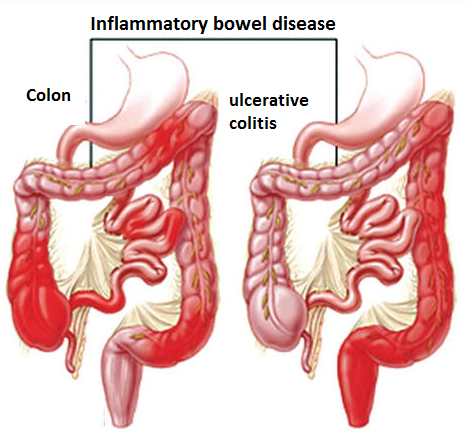
Ulcerative colitis is a chronic inflammatory condition that primarily affects the colon, leading to inflammation and ulcer formation along the inner lining. It typically begins in the rectum and may extend proximally in a continuous manner. The inflammation usually begins in the rectum and spreads upward in a continuous fashion, never skipping segments of the colon. While the exact cause remains unknown, UC is believed to result from an abnormal immune response triggered by genetic predisposition, environmental factors, and gut microbiota imbalance. UC often follows a relapsing-remitting course, with periods of active flare-ups followed by phases of remission. As a relapsing-remitting condition, UC significantly impacts the quality of life and requires long-term medical management or, in severe cases, surgical intervention according to Modern Medicine. Unlike some other gastrointestinal diseases, UC is limited to the colon and does not involve the small intestine. It can significantly impair a person’s quality of life, and in severe or long-standing cases, may increase the risk of colorectal cancer. Though more prevalent in Western countries, recent decades have seen a rising incidence in developing regions, likely due to westernized diets, lifestyle changes, and urbanization. With proper treatment and monitoring, many individuals with UC can lead stable and productive lives, although the disease demands continuous attention and care. Ayurveda has a different approach for this condition about which the one reading this article will get to know.
Causes Of Ulcerative Colitis
The exact cause of ulcerative colitis remains unknown; however, several contributing factors have been identified that may trigger or aggravate the condition:
- Genetic – Family history of IBD increases the risk.
- Immune System Dysfunction – An abnormal immune response attacks the lining of the colon.
- Environmental Factors – Pollution, urban lifestyle, and lack of exposure to infections may contribute.
- Dietary Habits – High-fat, low-fiber, and processed food diets may aggravate inflammation.
- Gut Microbe Imbalance – Altered intestinal flora may influence immune activity.
- Stress – While not a direct cause, stress can worsen symptoms or trigger flare-ups.
- Autoimmune Factors – UC is considered an autoimmune condition where the body mistakenly attacks its own intestinal tissue.
- Age – More common in people aged 15–30.
Symptoms Of Ulcerative Colitis
Ulcerative colitis presents with a range of symptoms that vary in intensity depending on the severity and extent of inflammation in the colon.
- Bloody diarrhea – Most common symptom due to mucosal ulceration.
- Abdominal pain and cramping – Especially in the lower left quadrant.
- Urgency to defecate – Sudden, uncontrollable urge to pass stool.
- Tenesmus – Feeling of incomplete evacuation after a bowel movement.
- Frequent bowel movements – Often with mucus and blood.
- Fatigue – Due to chronic inflammation, anemia, and poor nutrient absorption.
- Weight loss – From reduced appetite and malabsorption.
- Low-grade fever – During flare-ups or active disease.
- Anemia – From chronic blood loss in the stool.
- Dehydration – Especially in severe cases with persistent diarrhea.
- Joint pain – Extraintestinal manifestation, often in large joints.
- Skin rashes or ulcers – Erythema nodosum or pyoderma gangrenosum in severe cases.
- Eye inflammation – Uveitis or episcleritis in some patients.
- Growth retardation in children.
Diagnosis Of Ulcerative Colitis
The diagnosis of ulcerative colitis involves a combination of clinical evaluation, laboratory tests, imaging studies, and endoscopic examinations to confirm inflammation and rule out other conditions:
- Proper Medical History – Includes bowel habits, presence of blood in stool, and family history of IBD.
- Physical Examination – Abdominal tenderness, signs of anemia, and weight loss may be noted.
- Stool Tests – To rule out infections.
- Blood Tests – CBC, C-reactive protein or ESR.
- Colonoscopy with Biopsy.
- Imaging Tests – CT, MRI, barium enema.
Treatment
- Aminosalicylates
- Corticosteroids
- Immunosuppressants
- Supportive care
Ayurvedic Overview
In Ayurveda, Ulcerative colitis closely resembles Rakta Atisaar, a type of Atisaar (diarrhea) characterized by frequent passage of blood with stools. It is predominantly a Pitta dominant disorder, where aggravated Pitta Dosha vitiates Rakta Dhatu and disturbs Apana Vayu, leading to inflammation, ulceration, and bleeding in the colon as mentioned by Acharya Charaka in Atisar Chikitsa Adhaya in Chikitsa Sthan:
कुर्याद्रक्तातिसारंतुरक्तमाशुप्रदूषयेत् |
तृष्णांशूलंविदाहंचगुदपाकंचदारुणम् ||च.१९ /७०||
It leads to morbid thirst, colic pain, burning sensation, and suppuration of the anus. It can also manifest itself directly on account of excessive aggravation of Pitta and vitiation of blood. Also, predominantly aggravated Pitta causes inflammation, heat, and bleeding in the colon. Vata Dosha contributes to irregular bowel movement, cramping, and mucous formation. Kapha involvement may be minimal but can cause excessive mucus in stools when aggravated.
Main Causes Of The Disease
- Vata-Kapha imbalance: Aggravated Vata leads to irregular bowel movements, while excess Kapha causes mucus formation and heaviness in the colon.
- Mandagni (weak digestive fire): Poor digestion leads to Ama accumulation, which obstructs channels (Srotorodha) and causes inflammation.
- Rakta Dushti (vitiated blood): Impure blood contributes to bleeding, ulceration, and mucosal damage in the colon.
- Improper diet and lifestyle: Excess cold, oily, heavy, or incompatible foods, along with sedentary habits, aggravate doshas and weaken digestion.
- Stress and mental factors: Excessive worry or mental stress can disturb Vata, worsening bowel irregularities and inflammation.
Samprapti (Pathogenesis) Of Ulcerative Colitis
Having Improper Diet & Lifestyle
↓ Over time
Causes Mandagni (Weak Digestive Fire)
↓
Which leads to Ama Formation (Toxins)
↓
Eventually leads to Vata & Pitta Aggravation
↓
Which over time causes Srotorodha (Blocked Channels)
↓
Rakta Dushti (Vitiated Blood)
↓
Causes Inflammation & Ulceration of Colon
↓
Showing symptoms like Diarrhea with Mucus & Blood, Pain, Weakness
Ayurvedic Management
Ayurvedic management emphasizes Pitta Shamana (Pitta-pacifying), Rakt Stambhana (hemostatic), Agni Deepan (digestive fire correction), and Vrana Ropana (ulcer healing).
Herbal Treatment
- Kutaj (Holarrhena antidysenterica) – Anti-diarrheal, controls bleeding, balances Pitta and Kapha.
- Nagkesar (Mesua ferrea) – Reduces inflammation and Pitta, helps in blood in stools.
- Lodhra (Symplocos racemosa) – Astringent, controls chronic diarrhea, heals intestinal mucosa.
- Mochrus (Strychnos potatorum) – Reduces mucus and bleeding, strengthens colon.
- Amla (Emblica officinalis) – Anti-inflammatory, immunomodulatory, reduces Pitta.
- Bilva (Aegle marmelos) – Anti-diarrheal, balances Vata and Pitta.
- Commonly Used Formulations: Kutajghan Vati, Nagkesar Churna, Lodhra Churna, Bilwa Churna, Triphala Churna (for mild bowel regulation), Mahasudarshan Churna (for Pitta balance)
Diet
- Soft, light, and easily digestible foods (Khichdi, cooked vegetables, rice)
- Avoid spicy, oily, fermented, and junk foods
- Include cooling and astringent foods (cucumber, pomegranate, coconut water)
- Use ghee and honey in moderation for healing and lubrication
Lifestyle
- Avoid stress, excessive travel, and irregular routines
- Practice gentle yoga (Pawanmuktasana, Vajrasana) for bowel regulation
- Daily meditation and pranayama to reduce Pitta and stress
Panchakarma / Procedural Approaches
- Basti (medicated enema) – Kashaya or oil-based, helps Vata-Pitta balance and intestinal healing
- Snehana (oleation) and Swedana (steam therapy) – Before Basti, for Vata-Pitta regulation
Herbal Remedies For Ulcerative Colitis By Planet Ayurveda
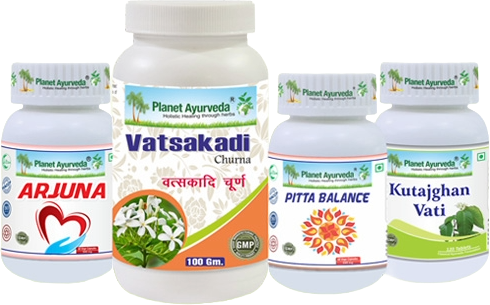
Planet Ayurveda is a globally acclaimed Ayurvedic brand known for its unwavering commitment to promoting health through 100% natural and herbal remedies. Every formulation by Planet Ayurveda is rooted in classical Ayurvedic texts while being validated by modern scientific research. The company’s manufacturing facility is GMP certified and each product undergoes strict quality control and lab testing to ensure safety, efficacy, and authenticity. Planet Ayurveda offers a wide range of formulations for digestive disorders, skin diseases, joint health, mental wellness, liver care, immunity, kidney health, and many chronic ailments. What sets Planet Ayurveda apart is its holistic approach—focusing not just on treating the disease but on restoring balance to the mind, body, and spirit. With a strong global presence and a loyal community of Ayurvedic practitioners and wellness seekers, Planet Ayurveda continues to be a trusted name in ayurvedic healthcare, delivering the wisdom of Ayurveda to every home. Moreover, it provides ulcerative colitis care packs for the patients suffering from this disease. It consists of the following:
Products Name
- Arjuna Capsules
- Vatsakadi Churna
- Pitta Balance
- Kutajghan Vati
Ulcerative Colitis Care Pack

Product Description
1. Arjuna Capsule
Arjuna Capsule by Planet Ayurveda is formulated using standardized extract of Terminalia arjuna, a time-tested Ayurvedic herb renowned for its cardioprotective and anti-inflammatory properties. In Ulcerative Colitis (UC), Arjuna works by soothing inflamed intestinal mucosa, reducing bleeding, and promoting ulcer healing due to its astringent (Kashaya) and wound-healing properties. Its rich antioxidant profile strengthens blood vessels, minimizes oxidative stress, and controls excessive Pitta and Rakta imbalance responsible for ulcers. Acting as a natural hemostatic and anti-diarrheal, Arjuna Capsules by Planet Ayurveda provide effective support in reducing symptoms like bleeding, diarrhea, and abdominal pain while promoting gut repair and overall colon health.
Dosage: 2 capsules twice daily with plain water after meal
2. Vatsakadi Churna
Vatsakadi Churna by Planet Ayurveda is a classical herbal formulation made from a blend of potent herbs like Kutaj (Holarrhena antidysenterica), Bilva (Aegle marmelos), Saunf (Foeniculum vulgare), Choti Elaichi (Elettaria cardamomum), Jaiphal (Myristica fragrans), and others. In Ulcerative Colitis (UC), it works by reducing intestinal inflammation, controlling diarrhea, and healing ulcerated mucosa. Kutaj acts as a natural anti-dysenteric and astringent, while Bilva balances excessive Pitta and strengthens digestion. The aromatic herbs relieve bloating, cramps, and indigestion. Together, Vatsakadi Churna by Planet Ayurveda restores gut balance, reduces bleeding and mucus in stools, and supports long-term colon health naturally.
Dosage: 1 tsp twice daily with plain water after meal
3. Pitta Balance
Pitta Balance by Planet Ayurveda is a unique formulation made with cooling calcium compounds in the form of Pishti such as Praval Pishti (Coral calcium), Akik Pishti (Agate calcium) and Mukta Pishti (Pearl calcium). In Ulcerative Colitis (UC), these Pishtis act as natural Pitta pacifiers, providing a cooling, soothing, and anti-inflammatory effect on the intestinal mucosa. They reduce acidity, burning, and bleeding while promoting mucosal healing. Their hemostatic and restorative action helps control blood loss and ulceration. Pitta Balance by Planet Ayurveda thus calms aggravated Pitta Dosha, reduces inflammation, and supports overall colon repair in UC.
Dosage: 1 capsule twice daily with plain water after a meal
4. Kutajghan Vati
Kutajghan Vati is a classical herbal formulation prepared from the bark of Kutaj (Holarrhena antidysenterica), known for its potent anti-diarrheal and astringent properties. It is highly effective in managing ulcerative colitis (Raktatisaar) by reducing inflammation, controlling loose stools, and healing the intestinal mucosa. Kutaj balances Pitta and Kapha doshas, stops rectal bleeding, and restores gut integrity. Its antimicrobial and immunomodulatory actions help eliminate pathogenic organisms while supporting healthy gut flora. Kutajghan Vati thus provides natural relief from symptoms like abdominal pain, diarrhea, and bloody stools, making it a key Ayurvedic remedy in chronic colitis conditions.
Dosage: 2 tabs twice daily with plain water after a meal
Conclusion
Ulcerative Colitis is a chronic inflammatory condition of the colon that affects the quality of life by causing frequent relapses and gastrointestinal discomfort. While modern medicine provides symptomatic relief, Ayurveda approaches Ulcerative Colitis as Raktatisara caused by an imbalance of Pitta dosha and vitiation of Rakta Dhatu (Blood tissue). Ayurvedic formulations like Kutajghan Vati, Pitta Balance, Vatsakadi Churna, and Arjuna Capsules work synergistically to reduce inflammation, heal the intestinal mucosa, and balance the doshas naturally. Along with herbal remedies, adopting a suitable diet, stress management techniques, and regular practice of Yoga and Pranayam can greatly enhance recovery and prevent relapses. Thus, a holistic Ayurvedic approach, when followed with consistency and care, offers long-term relief, restores digestive harmony, and improves overall gut health, making it a valuable complementary option in the management of ulcerative colitis.